
How High Should You Hang Curtain Rods? Height Above Window Guide

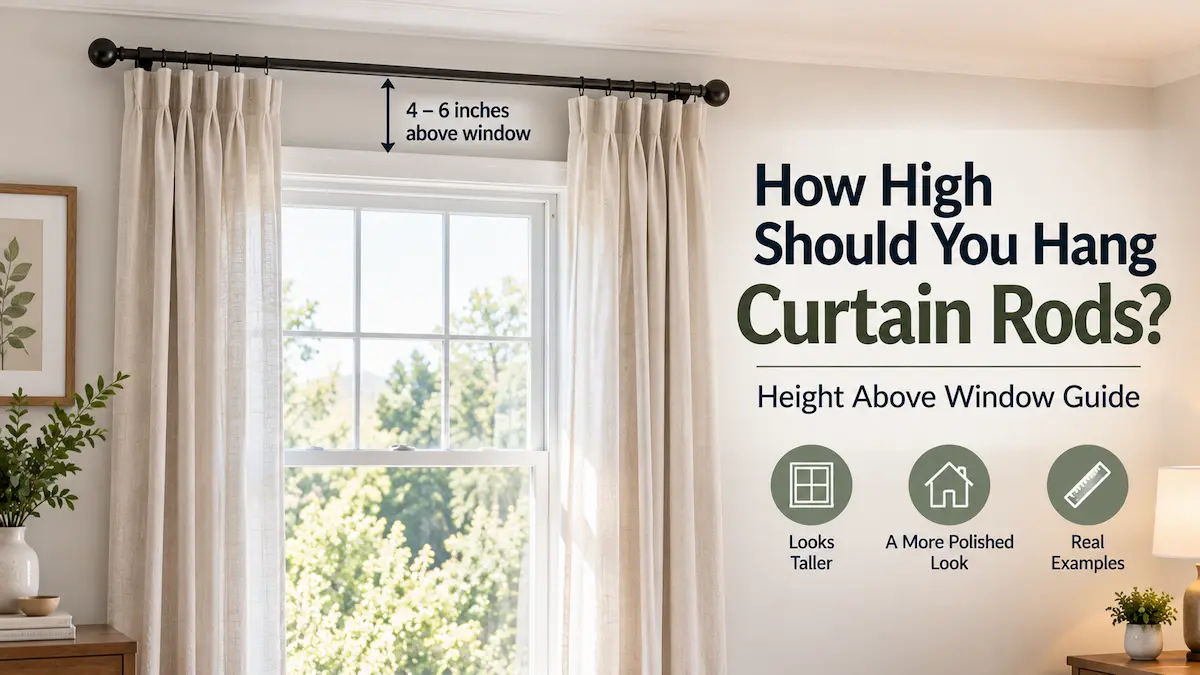
A curtain rod does not belong at one fixed height above every window. About 4 to 6 inches above the top window trim is a reliable conventional starting point, but the better placement depends on how much wall exists between the window and ceiling, where the curtains need to end, and how the panels attach to the rod.
Instead of asking only, “How many inches above the window?”, measure the entire window-to-ceiling gap. Then choose a rod position that keeps the curtains visually connected to the window while giving the room the height you want.
Pottery Barn recommends hanging rods about 4 to 6 inches above the window frame as a conventional approach, while West Elm’s installation guide uses 4 inches above the window as its standard bracket position. Treat that range as your first mock-up—not an automatic final measurement.
Start With the Space Above the Window
The most useful number is often the amount of wall between the top trim and the ceiling.
Use:
ceiling height − top-of-window-trim height = available mounting gap
For example:
- ceiling height = 96 inches;
- top of window trim = 80 inches above the floor.
The available gap is:
96 − 80 = 16 inches
Now you have a real design range to work with:
- 84 inches: rod 4 inches above the trim;
- 86 inches: rod 6 inches above the trim;
- 88 inches: roughly halfway through the gap;
- 90 inches: a higher, more elongated treatment.
The right answer is the one that looks balanced and still works with your curtain length and hardware.
Three Useful Rod-Height Zones
1. Conventional: about 4–6 inches above the trim
This is the safest starting point when the window has ordinary proportions and there is a moderate amount of wall above it.
It works especially well when:
- you want a classic rather than floor-to-ceiling look;
- ready-made curtain lengths naturally reach the intended hem;
- the window is not unusually close to the ceiling;
- there is no crown molding crowding the brackets.
If the treatment already looks balanced at 4 or 6 inches above the trim, there is no reason to move it higher simply because another room uses ceiling-height curtains.
2. Proportional: higher within the window-to-ceiling gap
Move the rod higher when the conventional position leaves an awkward band of unused wall above the curtains or when a taller treatment better suits the room.
Suppose the top trim is 82 inches from the floor and the ceiling is 102 inches high.
Available gap:
102 − 82 = 20 inches
A 6-inch rise puts the rod at 88 inches. A position roughly halfway through the gap puts it around 92 inches.
The halfway point is not a decorating rule. It is simply a useful second position to tape on the wall and compare before drilling.
3. Near-ceiling: when the architecture supports it
A near-ceiling rod or ceiling-mounted track can look especially intentional when:
- the window is already close to the ceiling;
- the ceiling is relatively low;
- you want a continuous floor-to-ceiling effect;
- several nearby windows are being treated as one wall;
- the hardware is designed for ceiling mounting.
Do not push ordinary wall brackets into the final inch of wall space without checking installation clearance. You still need room for the bracket, rod, finial, rings, screwdriver or drill, and any crown molding.
Rod Height and Curtain Length Have to Be Chosen Together
This is the part that prevents the most installation mistakes.
First decide where the finished curtain should end. For floor-length curtains, that may be:
- slightly above the floor;
- lightly touching the floor;
- breaking softly at the floor;
- puddling onto the floor.
Then test whether the curtain can actually reach that point from the proposed rod height.
Suppose a high rod position looks perfect at 92 inches above the floor, but your ready-made panels would stop several inches short of the floor. You have three sensible options:
- lower the rod;
- buy longer panels;
- change the hanging method if the curtain design allows it.
Do not drill at the visually ideal rod height first and solve the curtain-length problem afterward.
If you have not chosen the finished hem yet, use our curtain length guide before fixing the final rod position.
Measure the Fabric Hanging Point, Not Just the Bracket
“Six inches above the window” sounds exact, but different headers place the fabric at different heights relative to the rod.
Grommets
The rod passes through openings below the very top edge of the panel, so some fabric sits above the rod. Check the product’s measuring instructions before deciding the final bracket height.
Rod pockets and back tabs
These attach closely to the rod, making the relationship between rod height and finished panel length fairly direct, although the construction of the header still matters.
Clip rings
Clip rings suspend the fabric below the rod. That means the curtain can finish lower without moving the brackets.
Drapery rings and hooks
The hook setting and ring diameter determine the exact fabric position. With pleated or custom systems, use the manufacturer’s measuring method rather than a generic rod-height number.
What Changes With an 8-Foot Ceiling?
An 8-foot ceiling is 96 inches high, so curtain placement depends heavily on where the window ends.
If the top trim is 80 inches high, you have 16 inches of wall above the window. A 4-to-6-inch rise works conventionally, while an 8-to-10-inch rise creates a taller look without forcing the rod against the ceiling.
If the top trim is already 88 inches high, only 8 inches remain. In that situation, a rod 4 to 6 inches above the trim is naturally close to the ceiling, and that can look completely intentional.
The ceiling height did not change—the position of the window did.
What About 9-Foot or Taller Ceilings?
A taller ceiling does not mean the rod automatically needs to climb toward it.
If there is 24 or 30 inches between the window and ceiling, first mock up the conventional 4-to-6-inch position. Then test a moderately higher position, such as 8 to 12 inches above the trim.
Pottery Barn also notes that higher mounting can help a room feel taller, including placements around 8 to 12 inches above a window in suitable rooms.
What you generally want to avoid is a rod so high that a short window appears visually detached from the curtain header.
Crown Molding Sets a New Upper Limit
When crown molding is present, measure the usable wall between:
top of window trim → bottom of crown molding
For a conventional wall-mounted rod, the molding becomes the practical upper boundary.
Leave enough space for:
- the full bracket;
- the curtain header;
- the rod and finials;
- installation tools;
- easy removal of the rod later.
A rod positioned just beneath the molding often looks cleaner than hardware crowded into or visually overlapping decorative trim.
Very Tall and Sloped Ceilings Need Restraint, Not More Height
In a cathedral or double-height room, do not make the curtain rod chase a 16- or 20-foot ceiling just because it exists.
Treat the window and its surrounding wall as their own architectural zone. A moderate increase above the window often looks more connected than a rod mounted many feet above the glass.
With a sloped ceiling, most conventional curtain rods should still remain level unless the hardware and treatment were specifically designed for an angled installation. Mock up the placement visually when the ceiling creates very different wall gaps above each side of the window.
Multiple Windows Should Read as One Composition
If several similar windows share a wall, aligning the rods on one horizontal line usually looks cleaner than mounting every rod the exact same number of inches above its individual trim.
This matters when one window is slightly shorter than the others. Following a strict “6 inches above every window” rule can create a visibly uneven row of rods.
When the architecture and curtain lengths allow it, choose one common visual line.
Height and Width Work Together
Raising the rod makes a window feel taller. Extending the rod beyond the window helps more glass remain visible when the curtains are open.
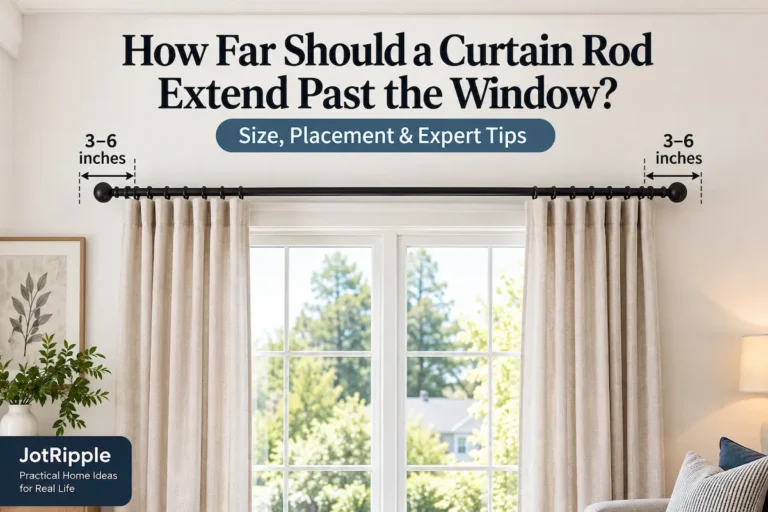
Pottery Barn recommends extending a rod roughly 3 to 6 inches beyond each side of the window frame as a general starting point.
The exact extension should still match your available wall space, curtain fullness, and how much fabric needs to stack beside the glass.
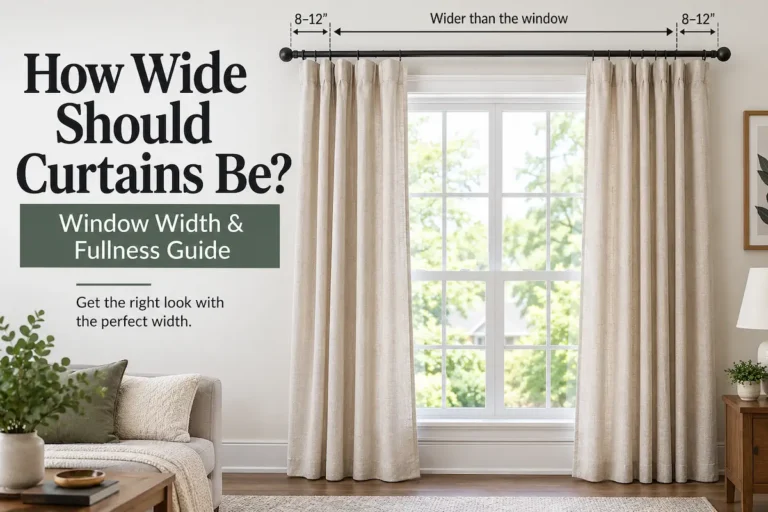
Rod placement also depends on panel fullness and stack-back, so calculate how wide your curtains should be before deciding the final rod extension.
Mock Up the Rod Before You Drill
A few pieces of painter’s tape can answer the question faster than another measurement rule.
- Measure the ceiling height.
- Measure the height of the top window trim from the floor.
- Calculate the available gap.
- Mark a conventional 4-to-6-inch rod position.
- Mark one higher proportional option if the wall space allows it.
- Measure from each proposed hanging point to the desired curtain hem.
- Confirm the panel length and header style.
- Mark the horizontal rod extension.
- Use a level to align both bracket positions.
- Confirm bracket, finial, molding, and tool clearance.
- Locate suitable framing or use anchors appropriate for the wall and curtain load.
- Only then drill.
The Placement I Would Use
For an ordinary window, I would begin by taping the rod position 4 to 6 inches above the top trim.
If that leaves too much unused wall above the treatment, I would test a higher position within the window-to-ceiling gap rather than automatically moving all the way to the ceiling.
If the window is already close to the ceiling, I would use the limited gap consistently—or use compatible ceiling-mounted hardware when that is the intended look.
And before drilling anything, I would confirm one final measurement: can the actual curtain, with its actual header, reach the intended hem from that rod height?
That check matters more than following any single “correct” number.
Questions Before You Hang the Rod
How many inches above a window should a curtain rod be?
About 4 to 6 inches above the top window trim is a reliable starting point for many conventional installations. Test a higher position when the room has more wall space above the window or when a taller treatment better suits the proportions.
Should the curtain rod be halfway between the window and ceiling?
It can be, but halfway is a visual reference rather than a rule. Compare it with a 4-to-6-inch-above-window position and choose the one that works better with the curtain length and room proportions.
Can a curtain rod be hung too high?
Yes. In a room with a very tall ceiling, placing the rod far above a short window can make the curtain treatment feel disconnected from the window. Higher is useful only while the composition still looks intentional.
Does curtain length determine rod height?
Partly. The proposed rod height has to work with the real panel length and hanging method so the curtain reaches the intended floor or sill position. Ready-made panel length often sets a practical limit on how high the rod can go.


2 Comments