
How Long Should Curtains Be? Floor, Sill & Puddle Length Guide

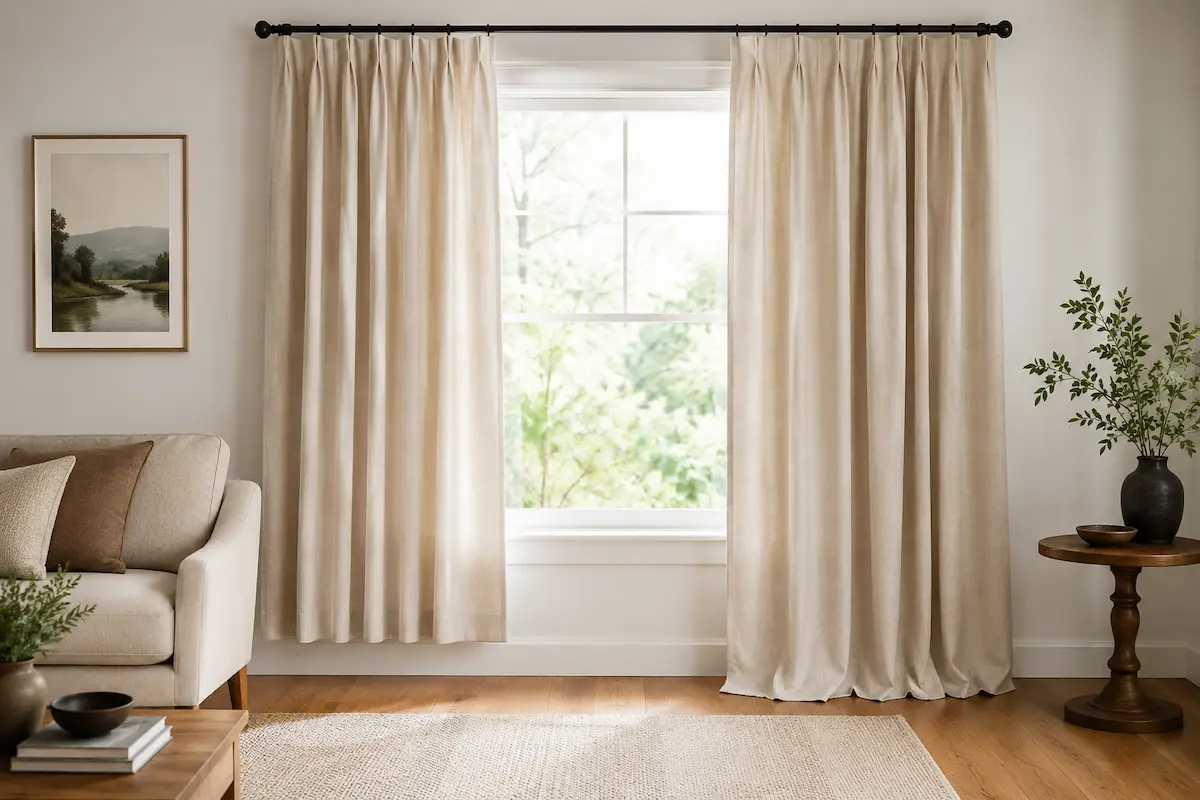
Look at the bottom edge of the curtain before worrying about the number printed on the package. In most living rooms, bedrooms, and dining rooms, the hem should reach the floor or stop very close to it. A clean everyday finish leaves only a small gap above the floor; a softer treatment can just touch, break, or deliberately puddle.
Shorter curtains have their place too. A sill- or apron-length panel may be the smarter choice above a kitchen counter, in front of fixed furniture, or anywhere full-length fabric would get in the way.
The important distinction is this: 84-, 96-, 108-, and 120-inch curtains are product sizes, not rules for where your curtains should end. Decide where you want the hem first, locate the hardware, and then measure the drop.
Start at the Bottom: Where Should the Curtain Hem Land?
For a window that can take full-length curtains, a difference of less than an inch can change both the look and the practicality of the treatment.
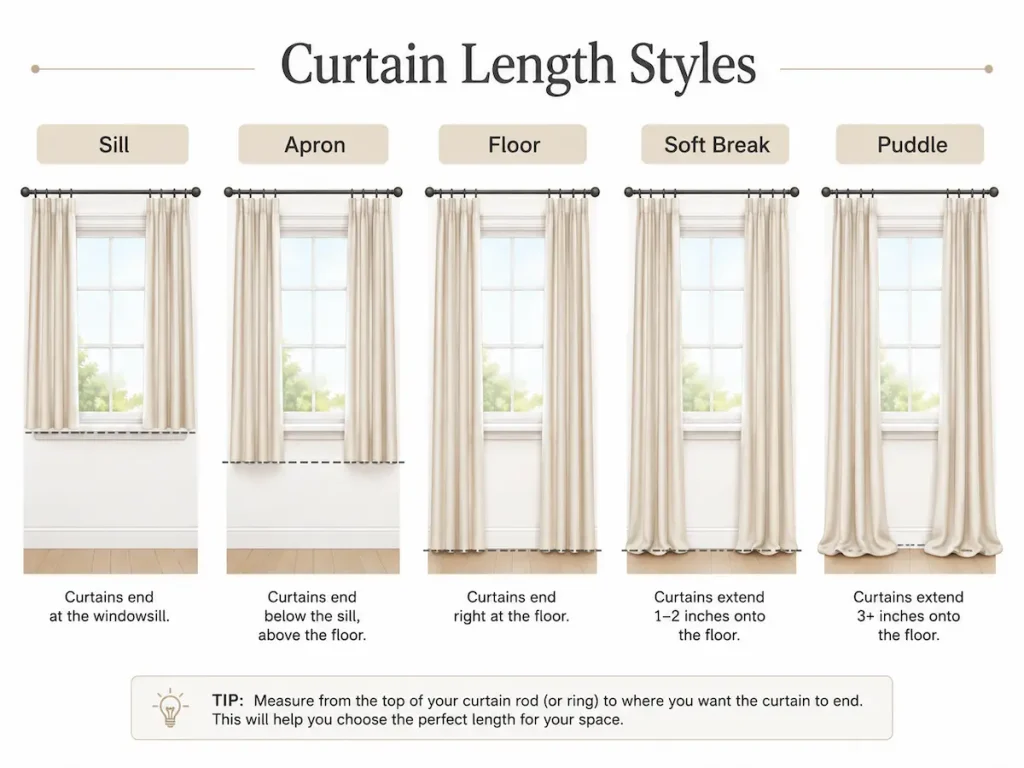
Float: slightly above the floor
A floating curtain ends just short of the finished floor. Around 1/4 to 1/2 inch above the floor creates a neat, tailored finish without letting the hem drag.
This is usually the easiest full-length treatment to live with if the curtains are opened often, you clean the floor regularly, or pets and a robot vacuum pass near the window. Current measuring guidance from The Shade Store uses the same 1/4- to 1/2-inch float as a practical measuring target.
Kiss: just touching the floor
A curtain that “kisses” the floor ends exactly where the finished floor begins. There is no obvious gap and no extra fabric folding at the bottom.
It is less forgiving than a float. If the rod is slightly out of level or the floor slopes, the difference becomes easier to notice, so measure at more than one point before committing to this finish.
Break: a little extra length
A break adds enough length for the fabric to bend gently where it meets the floor. About 1 to 2 extra inches creates a softer look without becoming a full puddle.
It can suit relaxed bedrooms, traditional rooms, and soft fabrics where a perfectly straight hem would feel overly rigid.
Puddle: fabric extending onto the floor
Puddled curtains are deliberately longer than the hanging-point-to-floor measurement. A restrained puddle commonly uses about 3 to 6 inches of additional fabric; more creates a fuller, more theatrical effect. The Shade Store uses that 3-to-6-inch range in its current measuring guidance, while West Elm shows a fuller 5-to-8-inch puddle as a formal, low-traffic treatment.
Puddling works best when appearance matters more than convenience. Fabric sitting on the floor collects more dust and pet hair and usually needs more arranging after cleaning.
Sill and apron lengths
Sill-length curtains stop at or around the windowsill. Apron curtains extend a short distance below it but stop well before the floor.
These shorter treatments make sense where the wall beneath the window needs to remain usable—over a sink, above a built-in desk or cabinet, or where another fixed feature prevents a free drop. West Elm’s current guide, for example, shows an apron treatment finishing about four inches below the sill.
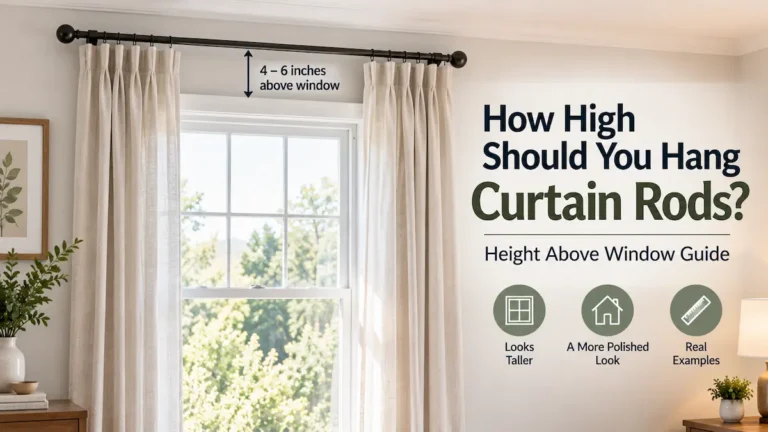
The starting point also depends on how high you hang the curtain rod, so decide the rod position before ordering a finished panel length.
Which Curtain Length Fits the Window You Actually Have?
Room labels are useful, but the wall around the window matters more than whether a retailer calls something a “bedroom curtain.” Start by checking what is below and beside the opening.
Living rooms and bedrooms
If the wall below the window is clear, floor-length curtains are usually the most cohesive choice. A float or floor kiss works well for rooms used every day; a small break or modest puddle is better suited to a more decorative setup.
For blackout curtains, remember that length is only one part of controlling light. Gaps at the sides and top matter too, so rod position and total coverage are just as important as the hem.
Kitchens and bathrooms
These are common exceptions to the floor-length preference. A window above a sink, counter, or work surface often suits a sill-length curtain, café curtain, shade, or another compact treatment better than fabric extending down the wall.
In bathrooms, privacy and moisture resistance may matter more than creating the longest possible visual line.
Windows with furniture or heating equipment below them
Do not shorten curtains automatically just because a sofa or table sits near the window. If the panels can hang freely behind it, floor length may still work.
But a built-in desk, cabinet, radiator, heater, or register changes the decision. Curtains should not interfere with required clearances or airflow simply to reach the floor. Follow the equipment manufacturer’s instructions and choose a shorter or different window treatment when necessary.
Sliding and patio doors
Full-length curtains naturally suit a floor-to-near-floor opening, but a large puddle can become annoying where people walk through regularly. A small float is usually easier to live with because the panel moves without dragging as much fabric across the floor.
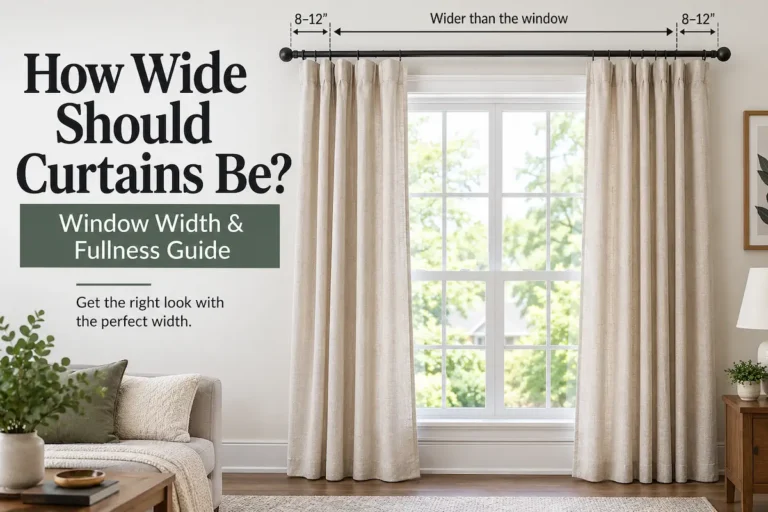
Length determines where the hem finishes, but you should also calculate how wide your curtains should be so the panels have enough fullness when closed.
Standard Curtain Lengths Are Shopping Sizes, Not Design Rules
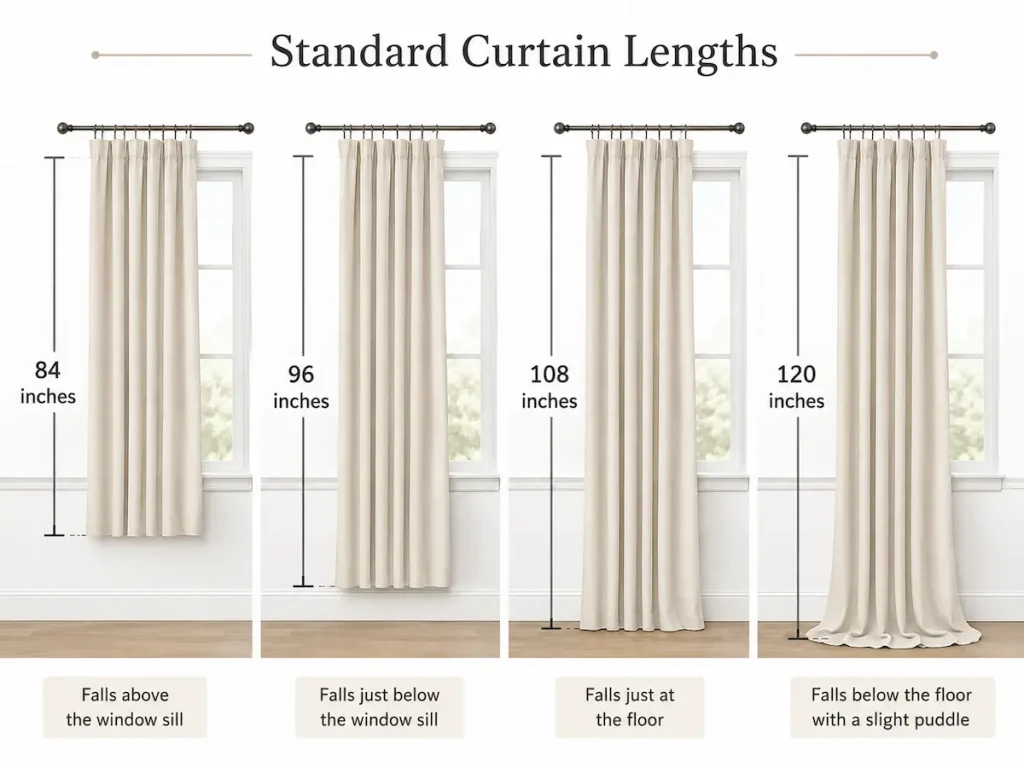
Ready-made curtains are commonly sold in recurring lengths. Pottery Barn currently lists 84, 96, 108, and 120 inches as standard curtain lengths in its window guide.
| Curtain length | Where it may be useful |
|---|---|
| 84 inches | Lower-mounted hardware or shorter wall/window layouts |
| 96 inches | Many higher-mounted installations in rooms with 8-foot ceilings |
| 108 inches | Taller walls or many 9-foot-ceiling installations |
| 120 inches | Very tall walls, high mounting points, or near floor-to-ceiling treatments |
Do not choose one of these lengths only because another home with the same ceiling height uses it. Two rooms with 8-foot ceilings can need different panels if one rod sits directly above the trim and the other is mounted much higher. Header style and hardware can change the finished position as well.
Measure From the Hardware, Not From the Ceiling
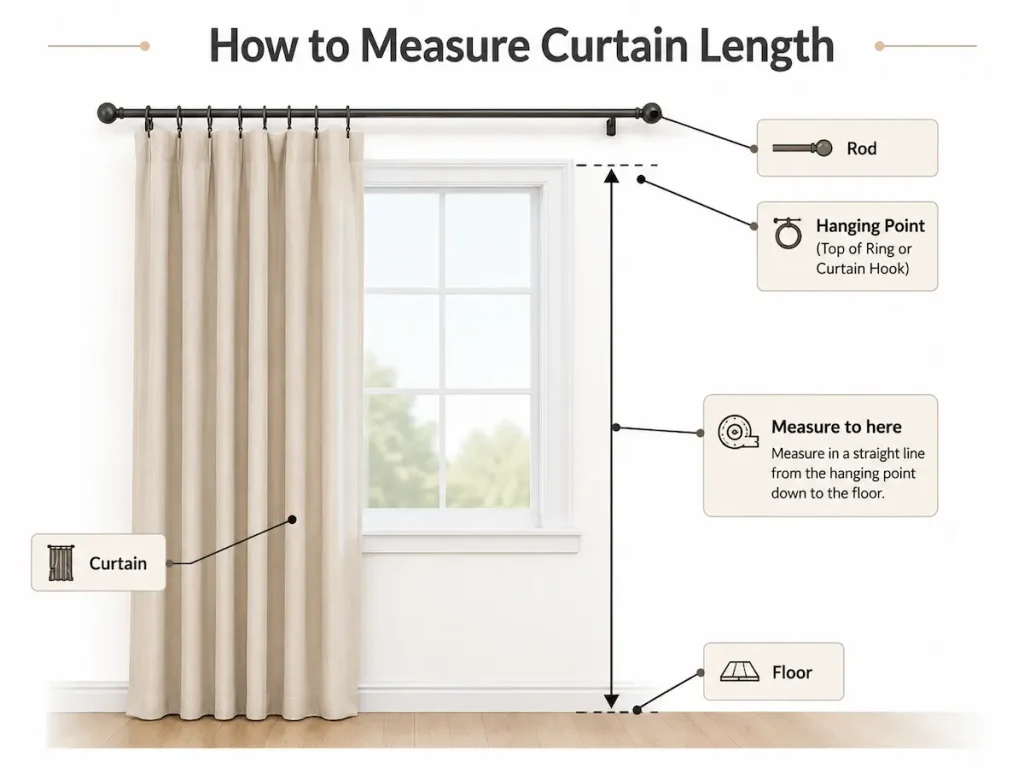
The safest way to determine curtain length is to work from the installed—or precisely planned—setup rather than estimating from ceiling height.
- Choose the final hem position. Decide whether the curtain will float, touch, break, puddle, stop at the sill, or finish below it.
- Determine the actual hanging point. This depends on whether you use rings, clips, grommets, hooks, a track, back tabs, or a rod pocket.
- Measure vertically to the intended endpoint. A metal tape measure is easier to keep straight than a soft sewing tape.
- Repeat the measurement. For floor-length curtains, check the left, center, and right if possible. Floors and rods are not always perfectly level.
- Adjust for the finish. Subtract a small amount for a float or add length for a break or puddle.
- Compare the finished measurement with the available panel sizes. If none lands correctly, plan to hem a longer curtain or use custom sizing.
Example: a floating curtain
Suppose the distance from the actual hanging point to the finished floor is 95 1/2 inches. If you want the hem 1/2 inch above the floor:
95 1/2 inches − 1/2 inch = 95 inches finished drop
A 96-inch ready-made panel may then need a small hem or an installation adjustment, depending on its heading and hardware.
Example: a puddled curtain
Suppose your hanging-point-to-floor measurement is 107 inches and you want about 4 inches of fabric resting on the floor:
107 inches + 4 inches = 111 inches finished drop
That falls between many standard ready-made sizes. A longer panel that can be hemmed is usually more flexible than trying to make a shorter panel reach farther.
Why the Same 96-Inch Curtain Can Hang Differently
“Rod height” and “finished curtain drop” are not always the same measurement. The way the panel attaches to the hardware changes where the fabric begins.
Grommets
The rod passes through openings within the upper part of the panel, leaving some fabric above it. Measuring only from the top of the rod does not directly tell you where the hem will land.
Rings and clip rings
Rings suspend the fabric below the rod. Clips can add another small drop. Check the specifications for the actual curtain and hardware rather than assuming every 96-inch panel hangs identically.
Rod pockets, back tabs, tracks, and hooks
These systems position the fabric differently again. With a track or custom drapery hardware, use the manufacturer’s measuring instructions because the relevant starting point may be the hook or carrier rather than the rod itself.
What If Your Measurement Falls Between Two Sizes?
This happens often. Imagine your ideal finished length is 94 inches, but the curtain you want is available only in 84 and 96 inches.
An 84-inch panel cannot be made longer without adding fabric. A 96-inch panel can usually be shortened, so the longer size gives you more flexibility—provided the fabric can be hemmed without damaging a border, pattern, or decorative edge.
Do not move the rod to an awkward position merely to rescue the wrong curtain size. Put the hardware where it makes sense for the window and room, then fit the curtain to that geometry.
Small Details Worth Checking Before You Hem
Uneven floors: measure in more than one place. A hem can touch perfectly on the left and drag on the right if the floor or rod is slightly out of level.
Carpet and rugs: measure to the finished surface where the curtain will actually hang. Do not measure to a subfloor hidden beneath carpet.
Fabric care: cotton, linen, and blended panels can behave differently after cleaning. Read the manufacturer’s care and shrinkage guidance before hemming an expensive curtain to an extremely precise floor kiss.
Pets and robot vacuums: if there is regular movement around the hem, a small float is generally easier to maintain than several inches of fabric resting on the floor.
A Final Length Check Before You Order
Before clicking “buy,” ignore the package size for a moment and run through the window itself:
- Is full-length fabric practical below this window?
- Do you want a float, kiss, break, puddle, sill, or apron finish?
- Is the rod or track installed, or is its exact position marked?
- Are you measuring from the point where the fabric actually hangs?
- Have you checked the drop in more than one place?
- Have you accounted for the heading and hardware?
- Will furniture, heating equipment, pets, or cleaning equipment interfere?
- If the exact length is unavailable, can a longer panel be hemmed?
Once those answers are clear, choosing between 84-, 96-, 108-, 120-inch, or another curtain length becomes much easier. The room determines the finished length first; the number on the package is the purchasing decision that comes afterward.
Questions That Still Come Up
How far should curtains be off the floor?
For a tailored floating treatment, about 1/4 to 1/2 inch is a useful target. A slightly larger gap can be practical where the floor is uneven, but an accidental several-inch gap usually looks too short when the curtain is meant to be floor length.
Are 84-inch curtains too short?
Not automatically. An 84-inch curtain is correct if it reaches your chosen endpoint from the actual hanging position. It is often too short when the rod is mounted high and the intended treatment is floor length.
Are 96-inch curtains right for 8-foot ceilings?
They work in many 8-foot-ceiling rooms, especially when the rod is mounted higher above the window, but ceiling height alone cannot determine the correct length. Rod position, heading style, hardware, and desired floor clearance all change the finished result.
How much extra curtain length is needed for a puddle?
About 3 to 6 extra inches is a practical starting range for a restrained puddle. More fabric creates a fuller look and also increases maintenance.

2 Comments