How Far Should a Curtain Rod Extend Past the Window?

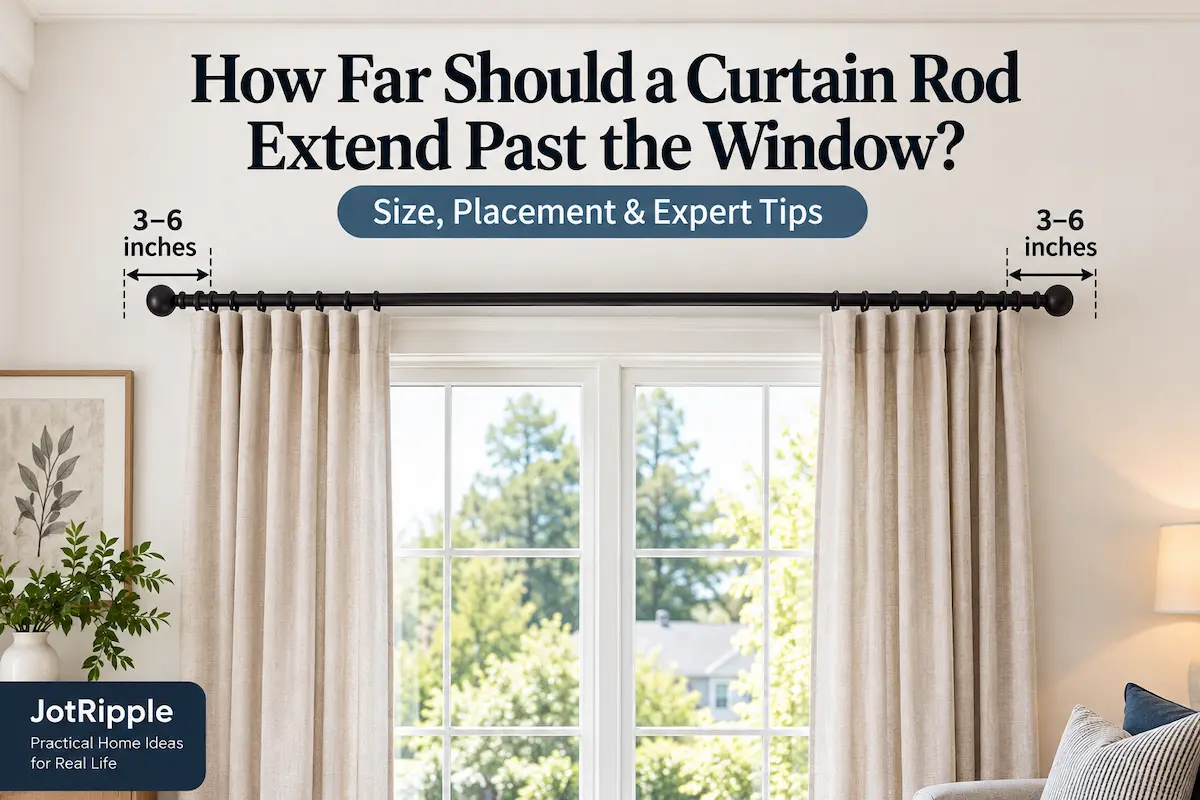
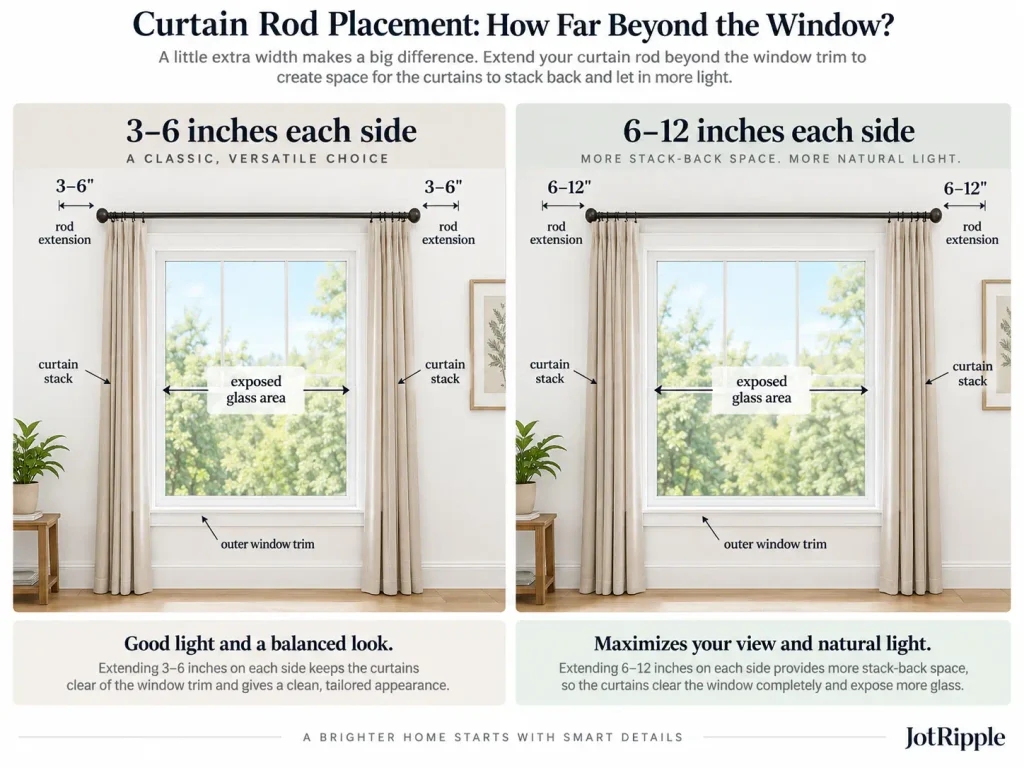
For most outside-mounted curtain rods, extending the rod about 3 to 6 inches past each side of the window frame is a practical starting point. If you have more wall space or want more of the curtain fabric to stack off the glass when open, extending roughly 6 to 12 inches per side can work better.
Those ranges are not contradictory. They solve slightly different problems. A modest extension keeps the treatment compact; a wider extension creates more stack-back space, which can expose more glass and make the window appear wider.
Pottery Barn recommends extending a rod about 3 to 6 inches beyond both sides of the frame. Crate & Barrel gives the same 3-to-6-inch starting range in its curtain sizing guide. The Shade Store uses a wider 6-to-12-inch extension for drapery when the goal is to move more fabric off the window when open.
The Rod Extension Is Really a Stack-Back Decision
When curtains are open, the folds gather beside the window. That gathered width is often called the stack or stack-back.
If the rod ends almost exactly at the window trim, much of that fabric has nowhere to go except in front of the glass.
Extending the rod farther onto the wall gives the open curtains somewhere else to sit.
- expose more of the glass;
- let more daylight into the room;
- make the window appear visually wider;
- reduce the amount of curtain fabric covering the view when open.
This is why a single universal number is not especially useful. Thin linen panels may create a fairly small stack. Lined blackout curtains, velvet, or very full drapery can occupy considerably more wall space when open.
Use This Formula Before Buying the Rod
Measure the window at the outside edges of the trim if that is the architectural frame you are mounting around.
usable rod span = window width + left extension + right extension
For a symmetrical installation:
usable rod span = window width + (2 × extension per side)
Example: 60-inch window
If you want the rod to extend 6 inches on each side:
60 + 6 + 6 = 72 inches
If you want 8 inches per side:
60 + 8 + 8 = 76 inches
If you want 12 inches per side:
60 + 12 + 12 = 84 inches
This is the usable curtain span. Decorative finials may extend beyond it, so do not automatically count the finial tips as part of the width the curtains travel across.
Rod-Width Examples for Common Window Sizes
| Window width | 4 in. each side | 6 in. each side | 8 in. each side | 12 in. each side |
|---|---|---|---|---|
| 36 in. | 44 in. | 48 in. | 52 in. | 60 in. |
| 48 in. | 56 in. | 60 in. | 64 in. | 72 in. |
| 60 in. | 68 in. | 72 in. | 76 in. | 84 in. |
| 72 in. | 80 in. | 84 in. | 88 in. | 96 in. |
These are planning numbers, not a requirement to choose the widest option. Your wall space and curtain stack still decide which column makes sense.
When 3 to 6 Inches Per Side Is Usually Enough
The conventional 3-to-6-inch range is a good first mock-up when:
- the curtains are moderately full rather than extremely bulky;
- there is limited wall beside the window;
- another window, cabinet, corner, or artwork sits nearby;
- you want the treatment to stay visually close to the window;
- you do not need every inch of glass uncovered when the curtains are open.
When 6 to 12 Inches Per Side Makes More Sense
Consider testing a wider extension when:
- the curtains are thick, lined, or very full;
- you want most of the open curtain stack off the glass;
- the window has generous blank wall on both sides;
- you are trying to make a small window appear wider;
- the treatment is custom drapery designed for a larger stack-back area.
The Shade Store currently recommends approximately 6 to 12 inches beyond the window for many drapery installations and, in some of its newer rod-installation guidance, uses about 12 inches per side as a broad best-practice starting point. That is a useful option when the architecture gives the curtains enough wall space to use it.
Do not force 12 inches into a room where the rod would collide visually or physically with a corner, cabinet, adjacent window, or other feature.
The Wider the Rod, the More Curtain Width You Need
Rod extension and curtain fullness are separate decisions, but they directly affect each other.
If a 60-inch window has an installed usable rod span of 76 inches because the rod extends 8 inches on each side, the curtains need to cover 76 inches when closed—not merely the 60-inch window.
At 2× fullness:
76 × 2 = 152 inches of total flat curtain width
This is why you should decide the rod extension before ordering the final panel width. Our curtain width and fullness guide walks through the complete calculation for ready-made panels, sheers, blackout curtains, and custom treatments.
Do Not Measure to the Finial Tips
The decorative finials at the ends of a rod can make the hardware substantially wider than the area the curtains actually use.
For extension planning, focus on the distance from the outside window trim to the usable curtain travel area.
Then separately check how much additional wall space the finials need.
- inside corners;
- bookcases and tall cabinets;
- closely spaced windows;
- wall sconces;
- artwork;
- door trim.
Closely Spaced Windows Need a Different Approach
If two windows sit close together, giving each one a 12-inch extension on every side may produce overlapping or crowded hardware.
- reduce the inward extension between the windows;
- use one longer rod to treat the windows as a group;
- keep the outside extensions wider and the center gap tighter;
- use a track system if the architecture suits it better.
A Window Near a Corner May Need Unequal Extensions
A rod does not always need exactly the same extension on both sides.
Suppose the left side of the window has 10 inches of open wall but the right side is only 4 inches from a corner. Trying to force a symmetrical 8-inch extension would not work.
A practical installation may use less extension on the constrained side and more wall space on the open side. Check the finished appearance with painter’s tape before drilling.
Stationary Side Panels Are Different
If your curtain panels are decorative and will never close across the window, rod extension becomes primarily a visual-placement decision.
You may use a wider rod to move the stationary panels almost completely onto the wall and leave the glass exposed.
Because the panels do not need to meet in the center, you also do not need to calculate their width as though they were functional closing curtains.
What About Sliding Glass Doors?
For a sliding or patio door, think about the active doorway rather than only the frame.
The curtain stack should not block the side people use to walk through.
If there is sufficient wall on the inactive side, an asymmetric one-way draw or wider stack-back zone may be more practical than splitting the curtains evenly.
Set the Rod Height Before You Drill the Brackets
Horizontal extension is only half of the installation.
Once you have marked the left and right bracket positions, confirm the vertical position as well. Our curtain rod height guide explains how the common 4-to-6-inch-above-window starting point changes with ceiling height, crown molding, and the window-to-ceiling gap.
After the final rod position is established, use the curtain length guide to check whether your panels will reach the floor, sill, apron, or other intended endpoint.
Use Painter’s Tape to Compare Extensions Before Drilling
- Measure the outside width of the window trim.
- Mark the center of the window.
- Use painter’s tape to mark a rod 4 or 6 inches beyond each side.
- Mark a second option at 8, 10, or 12 inches if the wall allows it.
- Hold or approximate the curtain stack beside each mark.
- Check the arrangement from across the room.
- Confirm the finials will clear corners, furniture, and neighboring windows.
- Confirm the rod’s height and the curtain’s finished length.
- Use a level before drilling the brackets.
The Extension I Would Start With
For an ordinary living-room or bedroom window, I would first mock up 4 to 6 inches past each side of the outer trim.
Then I would ask one question:
Is there enough wall space for the curtain stack to move mostly off the glass?
If not, and the wall allows it, I would test 8 to 12 inches per side.
That approach is more useful than treating either 6 inches or 12 inches as a universal rule. The right extension is the smallest one that gives the open curtains enough stack-back space while still fitting the architecture of the room.
Questions People Ask Before Installing the Rod
How far should a curtain rod stick out past a window?
About 3 to 6 inches past each side of the window frame is a common conventional starting range. If you have more wall space or thick, full curtains that need a larger stack-back area, test approximately 6 to 12 inches per side.
Is 6 inches past each side enough?
Often, yes. Six inches per side gives many ready-made curtains useful wall space when open. Very full or heavily lined drapery may need more room if your goal is to uncover most of the glass.
Does curtain rod length include the finials?
Product labeling varies, so check the manufacturer’s dimensions. For layout planning, distinguish the usable span where the curtains travel from the additional width occupied by decorative finials.
Should the curtain rod be wider than the window?
For most outside-mounted curtains, yes. Extending the rod beyond the frame gives the open curtain stack wall space beside the glass and can make the treatment appear wider and more substantial.