
How Wide Should Curtains Be? Window Width & Fullness Guide

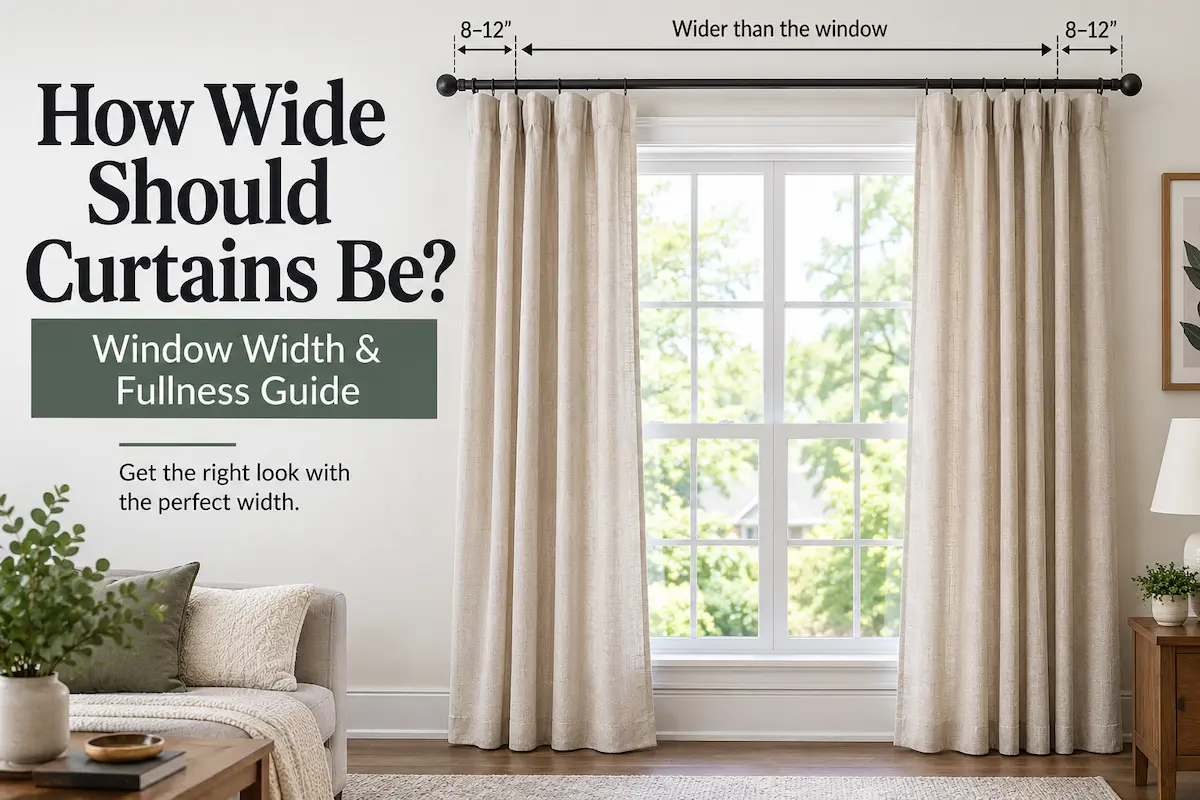
Curtain width mistakes are easy to miss while the panels are open. The problem usually appears when you close them: fabric that looked generous at the sides can suddenly stretch almost flat across the window.
For ordinary ready-made curtains, a practical starting point is to have about 1.5 to 2 times as much flat curtain width as the span the curtains need to cover. If you want fuller folds, or you are using lightweight sheers, you may need more. The key is to calculate from the usable curtain rod or track width when it extends beyond the window—not automatically from the glass or window frame.
So if your usable rod span is 72 inches and you want 2× fullness:
72 × 2 = 144 inches of total flat curtain width.
With two equal panels, that is about 72 inches of flat width per panel.
First, Measure the Span the Curtains Will Actually Cover
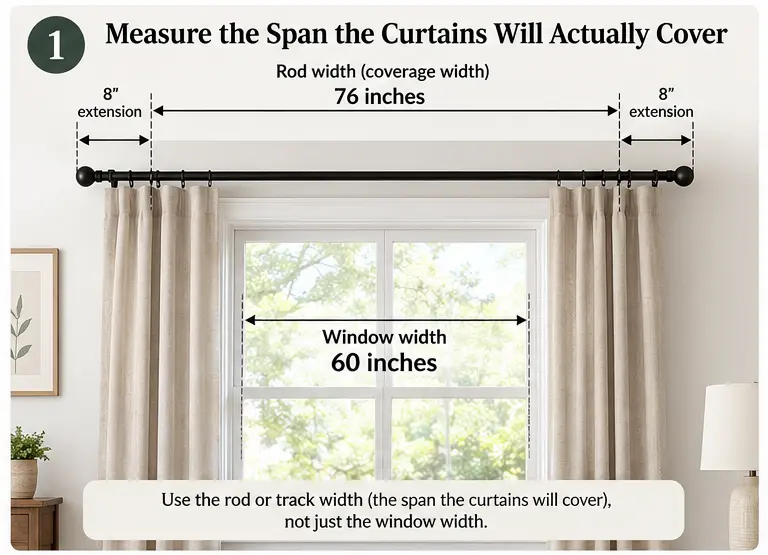
“Twice the window width” is a common shortcut, but it can give the wrong answer when the curtain rod extends beyond the frame.
Suppose the window itself is 60 inches wide, but the usable part of the rod is 76 inches wide because it extends 8 inches beyond the frame on each side.
If you double only the window:
60 × 2 = 120 inches
If you calculate from the rod:
76 × 2 = 152 inches
That is a 32-inch difference in total fabric width.
The second calculation better reflects the span the curtains need to close across. The Shade Store’s current curtain measuring guide likewise recommends calculating panel width from the area being covered or the hardware span, then adding fullness.
When measuring the rod, use the usable span where the curtain can travel. Decorative finials outside that travel area normally are not part of the coverage width.
Fullness Is What Keeps Closed Curtains From Looking Flat
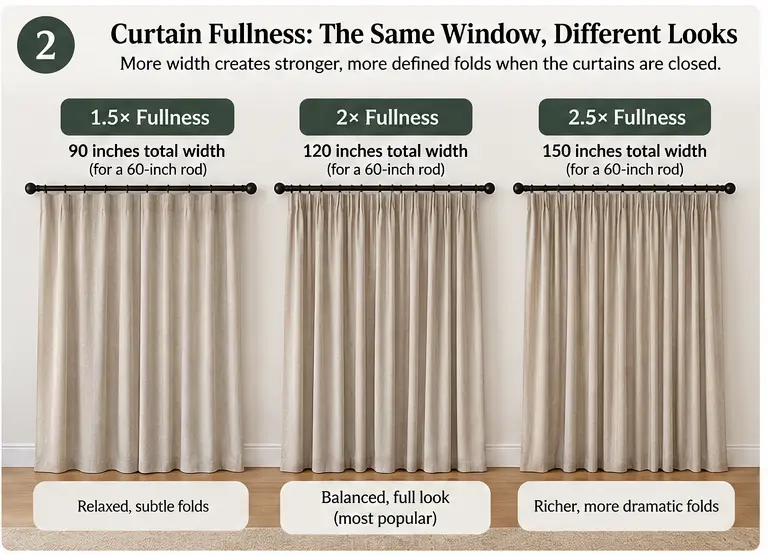
Curtain fullness is simply the relationship between the fabric’s flat width and the width it covers when hanging.
The useful formula is:
Total flat curtain width = usable rod or coverage width × fullness ratio
For a 60-inch rod, that gives:
- 1.5× fullness: 90 inches total
- 2× fullness: 120 inches total
- 2.5× fullness: 150 inches total
- 3× fullness: 180 inches total
The extra fabric does not cover a bigger window. It stays in folds and gathers when the curtains are closed.
1.5×: cleaner and less gathered
At 1.5× fullness, the curtains have 50% more fabric width than the area being covered. The folds are shallower, which can work well with thick, lined, or visually heavy fabric, or when there is limited wall space for the curtains to stack when open.
2×: the most useful general starting point
For many ordinary living-room and bedroom curtains, 2× fullness is a sensible place to start. It gives the fabric enough width to retain visible folds after the panels are drawn closed.
Pottery Barn’s current curtain guide similarly recommends doubling the measured width when a fuller, more gathered look is wanted.
2.5× to 3×: useful for some sheers and lightweight fabrics
Thin fabric has less visual mass, so low fullness can make it look especially flat. The Shade Store notes that some lightweight sheers may benefit from roughly 2.5× to 3× the coverage width.
That does not mean every curtain looks better at 3×. Heavy velvet or lined blackout panels at very high fullness can create a bulky stack and put more weight on the hardware.
Once you know the correct fullness, use the curtain length guide to determine where the panels should finish at the sill or floor.
A Width Table You Can Actually Use
The numbers below are the combined flat width of all panels, not the width of one panel.
| Usable rod width | 1.5× fullness | 2× fullness | 2.5× fullness |
|---|---|---|---|
| 36 in. | 54 in. | 72 in. | 90 in. |
| 48 in. | 72 in. | 96 in. | 120 in. |
| 60 in. | 90 in. | 120 in. | 150 in. |
| 72 in. | 108 in. | 144 in. | 180 in. |
| 84 in. | 126 in. | 168 in. | 210 in. |
| 96 in. | 144 in. | 192 in. | 240 in. |
If your result falls between products, you do not have to hit a perfect 2.00× ratio. A practical result such as 1.8× or 2.2× can still look good if the panels cover the full span and retain the folds you want.
The Package Width Is Where Many People Get Tripped Up
Once you know the total width you need, check whether the product’s listed width refers to one panel or the entire pair.
A listing that says:
52 in. W × 96 in. L
may be describing one 52-inch-wide panel. If two panels are included, the combined width is 104 inches. If only one is included, you would need to buy a second panel to get that total.
Never assume “52-inch curtains” means 104 inches of fabric without checking the package contents.
Example: two 52-inch panels on a 48-inch rod
At 2× fullness, a 48-inch rod needs:
48 × 2 = 96 inches total
Two 52-inch panels provide:
52 + 52 = 104 inches
Your actual fullness is:
104 ÷ 48 ≈ 2.17×
That is close to the 2× target and should work well for many ready-made curtains.
Example: two 52-inch panels on a 72-inch rod
A 72-inch rod at 2× fullness needs 144 inches total. Two 52-inch panels provide only 104 inches:
104 ÷ 72 ≈ 1.44×
They may still close, but the curtains will have noticeably less fullness than the 2× example.
Four 52-inch panels would swing the other way:
208 ÷ 72 ≈ 2.89×
That may be more fabric than you want. In that situation, two wider panels, a different ready-made product, or custom sizing may be a cleaner solution.
Fabric Changes How Much Fullness Feels Right
Sheer curtains
Sheers often benefit from more fabric because their light weight can look visually sparse when pulled across a wide span. Around 2.5× is a useful point to test; some very lightweight treatments may look better closer to 3×.
If you are layering sheers behind heavier curtains, calculate the two layers separately. They do not have to use the same fullness.
Blackout, velvet, and heavily lined curtains
Heavy curtains still need enough width to form folds when closed, but extreme fullness has consequences. More material means a larger stack beside the window, more weight on the brackets, and more fabric to move each time the curtains open.
For many heavy ready-made panels, roughly 1.5× to 2× is a more practical range to investigate than automatically jumping to 3×.
Heading Style Can Change the Ordering Method
The simple multiplication method is especially useful for flat ready-made panels such as many grommet, rod-pocket, and back-tab curtains.
Custom drapery is different.
Grommet, rod-pocket, and back-tab panels
For ordinary ready-made versions, compare the combined flat panel width with the usable rod span. The fullness ratio gives you a practical way to judge how gathered or flat the treatment will look.
Pinch pleats, ripple folds, and custom track systems
Do not automatically double an ordering width supplied by a custom workroom. Many custom systems ask only for the finished coverage width and build the necessary fabric fullness into the pleats or track spacing.
The Shade Store, for example, says customers ordering its custom drapery provide the width to cover and the company accounts for fullness and stack during production. For any made-to-measure system, follow that manufacturer’s measuring instructions rather than applying a ready-made-panel multiplier a second time.
Rod Width and Curtain Width Are Two Different Decisions
A wider rod can let the curtains stack farther onto the wall when open, exposing more glass. Fullness determines how much fabric you have across that rod when the curtains are closed.
They affect each other, but they are not the same calculation.
For outside-mounted curtains, current guides commonly extend the rod beyond the window frame when wall space allows. The exact amount varies by room and hardware. Pottery Barn suggests extending the rod several inches beyond each side, while The Shade Store’s guidance allows wider extensions when the goal is to move more of the curtain stack off the glass.
Once you have chosen that final usable rod span, then calculate curtain fullness from it.
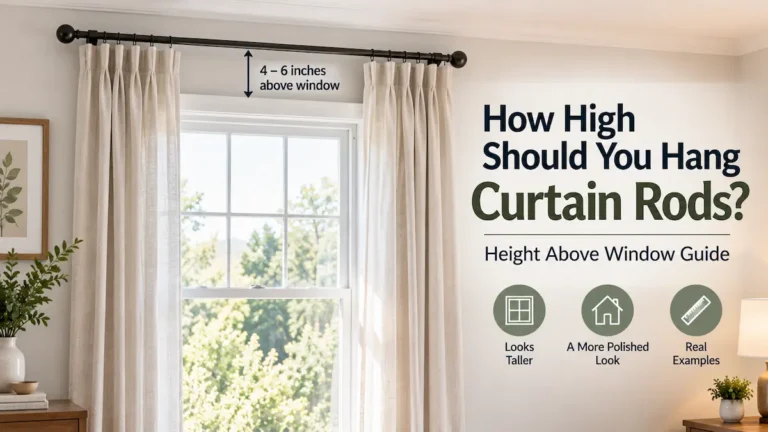
Before taking the final vertical measurement, also decide the curtain rod height, because raising the rod changes the finished curtain length you need.
Sliding Doors and Extra-Wide Openings Need Stack Space Too
For a sliding glass or patio door, calculate from the full usable track or rod span—not one door panel.
If the track is 96 inches wide:
- 1.5× fullness = 144 inches total curtain width
- 2× fullness = 192 inches
- 2.5× fullness = 240 inches
But width is only half the decision. A frequently used door also needs enough space for the curtains to stack without blocking the active doorway. A very full treatment can be beautiful when closed and frustrating every time someone needs to go outside.
Stationary Side Panels Do Not Need the Full-Coverage Formula
Some curtains are decorative only. They stay at the sides of a window while a blind or shade provides privacy and light control.
If the panels will never close across the opening, their width can be chosen for the visual effect and stack you want rather than calculated from the entire rod width.
Before choosing narrow stationary panels, make sure you will not later expect them to function as closing curtains.
Run This Check Before You Order
Before buying curtains, make sure you can answer all of these:
- What is the usable rod or track width?
- Do the curtains need to close completely?
- What fullness suits the fabric: roughly 1.5×, 2×, or more?
- What total flat panel width does that calculation produce?
- Is the product width listed per panel or per pair?
- How many panels will give you a sensible final fullness?
- Where will all of that fabric stack when open?
- Is the rod and bracket system appropriate for the weight?
- If the curtains are custom pleated, does the manufacturer want finished coverage width instead of multiplied fabric width?
For ordinary ready-made curtains, 2× the usable rod width is a strong general starting point. Treat it as a sizing tool, not a rigid rule. The best width is the one that covers the actual span, keeps enough folds when closed, and does not create an impractical wall of fabric when open.
Questions People Ask While Shopping
Should curtains be twice the width of the window?
About 2× fullness works well for many ordinary curtains, but calculate from the actual coverage or usable rod width when the rod extends beyond the window frame. Doubling only the glass width can leave a wide-mounted treatment short on fabric.
How wide should curtains be for a 60-inch window?
First determine the usable rod width. If the rod itself is 60 inches, 1.5× fullness needs 90 inches of total curtain width, 2× needs 120 inches, and 2.5× needs 150 inches. If the rod is wider than the window, calculate from that wider measurement instead.
How wide should curtains be for a 72-inch span?
If 72 inches is the actual usable rod or coverage width, 108 inches gives 1.5× fullness, 144 inches gives 2×, and 180 inches gives 2.5×.
Do pleated curtains need twice the ordered width?
Not necessarily. Many custom pleated or track-based systems build fullness into the finished product and ask you only for the coverage width. Follow the manufacturer’s ordering instructions instead of automatically doubling that measurement.


One Comment