
What Size Rug Goes Under a Full Bed? Size & Placement Guide

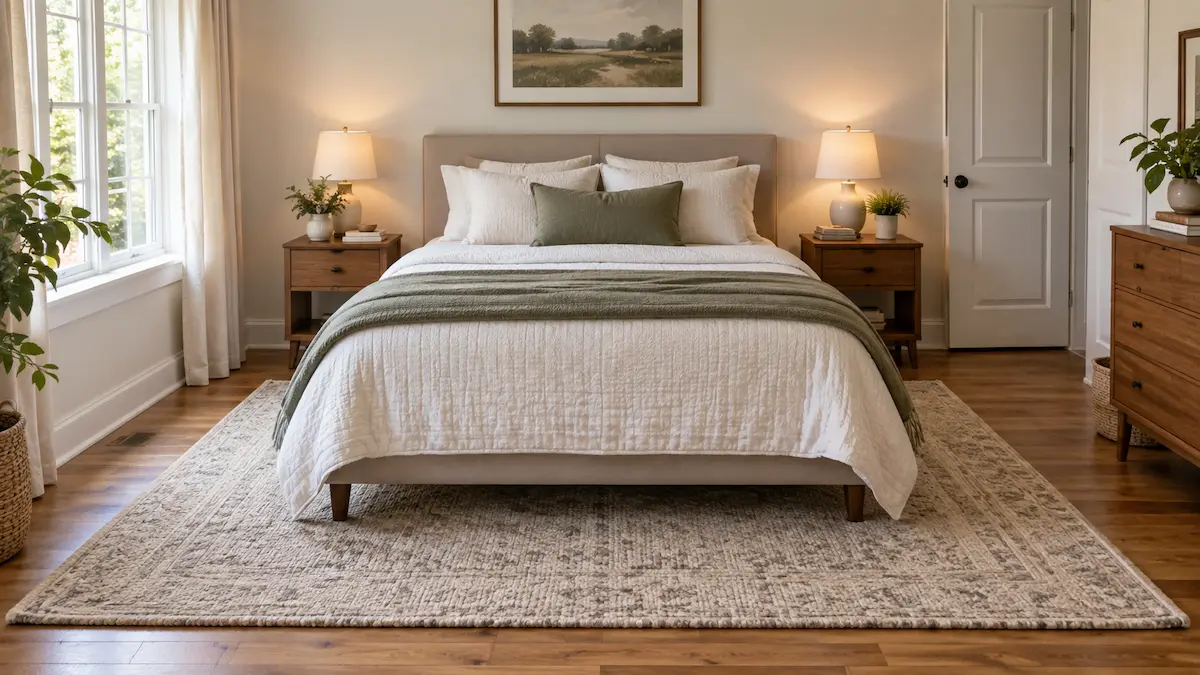
For most full beds, a 6×9-foot rug is the best place to start—but orientation matters as much as size. Turn the rug so the 9-foot side runs from one side of the bed to the other. That gives you substantially more usable rug where your feet actually land.
A 5×8 can work well in a compact bedroom, while an 8×10 is better when you want broader coverage or want the nightstands included in the rug zone.
A standard U.S. full mattress, also called a double, measures about 54 inches wide by 75 inches long. Sleep Foundation lists those standard dimensions in its full-size bed dimensions guide. Your finished bed frame may be several inches larger, so use the frame—not only the mattress—before making the final rug decision.
Turn the Rug Before You Judge the Size
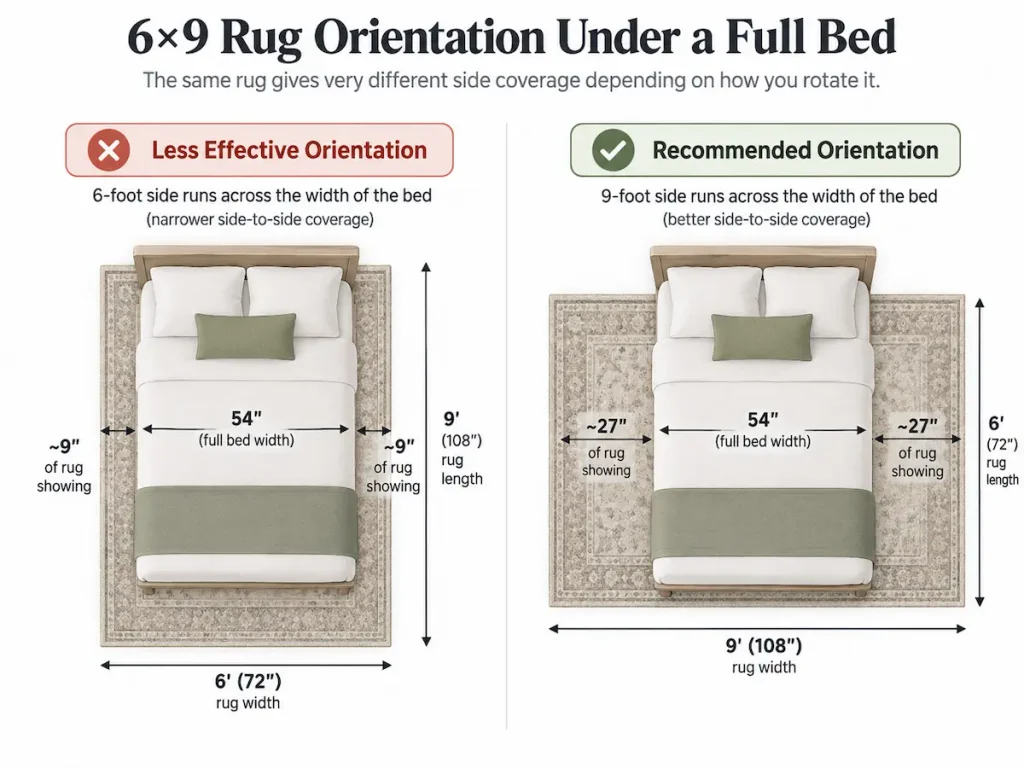
A 6×9 rug can behave like two completely different rugs under a full bed depending on which direction you turn it.
If the 6-foot side runs across the bed:
72 − 54 = 18 inches
Centered beneath the mattress, that leaves only about:
9 inches of rug per side
And the visible amount becomes even smaller once the bed frame is included.
Rotate the same rug so the 9-foot side runs across the bed:
108 − 54 = 54 inches
54 ÷ 2 = 27 inches per side
The rug did not become larger. The orientation simply puts its longest dimension where a bedroom rug usually needs the most coverage.
The same principle generally works for a 5×8 and 8×10: run the longer rug dimension across the width of the bed, with the shorter dimension extending from the head of the bed toward the foot.
5×8, 6×9, or 8×10: Which One Fits Your Layout?
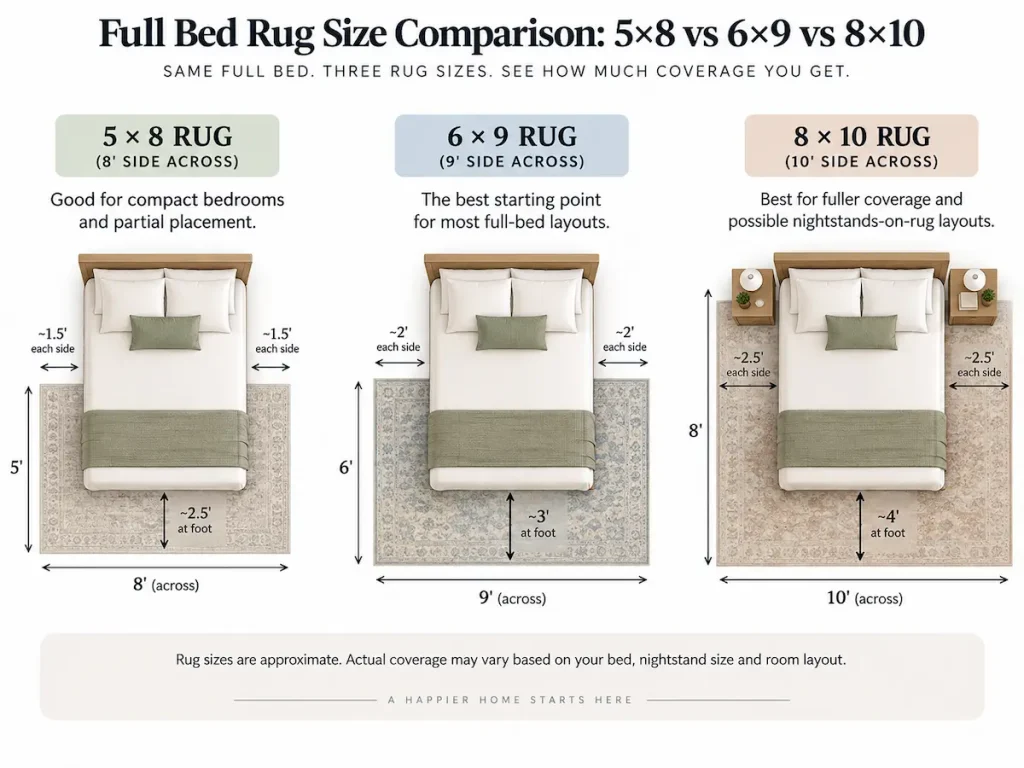
| Rug size | Recommended orientation | Best use |
|---|---|---|
| 5×8 ft | 8-ft side across the bed | Compact bedroom; nightstands off the rug |
| 6×9 ft | 9-ft side across the bed | Best starting point for most full-bed layouts |
| 8×10 ft | 10-ft side across the bed | Larger room; fuller coverage; possible nightstands-on-rug layout |
5×8: useful when the room is tight
Turn the 8-foot side across the bed and you have 96 inches of rug width.
Against a 54-inch mattress:
96 − 54 = 42 inches
42 ÷ 2 = 21 inches per side
That is before accounting for the frame, but it can still create a useful soft landing beside the lower portion of the bed.
The limitation is depth. A 5×8 rug is only 60 inches deep, while the mattress is about 75 inches long. That means the rug usually works best when it begins partway down the bed rather than at the headboard.
A 5×8 makes the most sense when the room is narrow, the nightstands stay on the flooring, and an 8×10 would consume too much of the visible floor.
6×9: the best all-around starting point
For most full beds, this is the size I would test first.
With the 9-foot dimension across the bed, a 54-inch mattress has about 27 inches of rug beyond each side before the frame is included.
The rug’s 6-foot depth is usually better suited to partial under-bed placement than trying to place the entire bed and nightstands on the rug.
For example, if about 54 inches of the rug’s 72-inch depth sits beneath the bed, roughly 18 inches can remain exposed beyond the foot. The exact amount will depend on the overall length of the frame and where you start the rug.
This arrangement concentrates the rug where people step out of bed while allowing the nightstands to remain directly on the flooring.
8×10: when you want the bed zone to feel larger
With the 10-foot side running across the bed, the rug is 120 inches wide.
Compared with the 54-inch mattress:
120 − 54 = 66 inches
66 ÷ 2 = 33 inches per side
The 8-foot rug depth also gives you much more flexibility from head to foot.
This size is worth considering when you want the bed, nightstands, and possibly a small bench to read as one larger furniture group. It can also make sense when the bedroom itself is spacious enough that a 5×8 or 6×9 would look undersized.
Do not choose it automatically, though. In a compact room, an 8×10 can come too close to walls, doors, or other furniture and make the remaining floor feel like a narrow border around the rug.
Use the Bed Frame to Calculate the Real Side Exposure
Pottery Barn’s current bedroom-rug guidance suggests approximately 18 to 24 inches of rug beyond the edge of a bed as a useful bedroom target.
That is a planning guideline, not a requirement. In a smaller room, slightly less may work; in a larger room, more can look appropriate.
For your own bed, use:
(rug width across the bed − actual bed-frame width) ÷ 2 = visible rug on each side
Suppose your finished full bed frame is 60 inches wide and you are considering a 6×9 rug with the 108-inch side across the bed:
(108 − 60) ÷ 2 = 24 inches
You would have about 24 inches of rug beyond each side of the frame.
This is more useful than choosing from mattress dimensions alone because upholstered borders, platforms, and side rails can add several inches to the furniture footprint.
Where Should the Rug Begin Under a Full Bed?
There are two practical layouts, and they solve different problems.
Keep the nightstands off the rug
This is the most efficient use of a 5×8 or 6×9.
Start the rug below the nightstands and move it toward the foot until you have useful exposure on both sides and beyond the foot of the bed.
This layout uses less rug while still putting softness exactly where people step down from the mattress.
Include the nightstands in the rug zone
If you want the bed wall to feel like one continuous furniture arrangement, an 8×10 is the more practical starting point.
Before buying, measure from the outside edge of one nightstand to the outside edge of the other. Large nightstands or a wide upholstered frame may require more width than a generic rug chart assumes.
There is no requirement that nightstands sit on the rug. Choose the layout that fits the room rather than treating one arrangement as universally correct.
The Room Can Rule Out a Rug That Looks Correct on Paper
A rug has to fit the bedroom as well as the bed.
Check:
- the distance from the bed to both side walls;
- bedroom and closet door swings;
- under-bed storage drawers;
- dresser drawers;
- floor vents or registers;
- furniture at the foot of the bed;
- the height of nearby doors if the rug and pad are thick.
If you are choosing between a full and a larger mattress because the bedroom feels tight, compare your room against our bedroom size guide for a queen bed before committing to both a larger bed and a larger rug.
A larger rug is not automatically the better rug if it creates clearance problems elsewhere in the room.
What If the Bed Is Against a Wall?
Do not force symmetry when the room is not symmetrical.
If one side of the full bed sits against a wall, shift the rug toward the accessible side so more of the material appears where someone actually walks.
In a very narrow room, a runner may be a better purchase than an area rug that spends most of its surface hidden beneath the mattress.
Smaller Than 5×8: When the Main Rug Starts Losing Its Job
A 5×7 can work in a tight bedroom, but the usable side coverage is noticeably smaller.
With the 7-foot side across a 54-inch mattress:
(84 − 54) ÷ 2 = 15 inches per side
And the actual bed frame will reduce that number further.
A 4×6 is more difficult to use as the main centered rug:
(72 − 54) ÷ 2 = 9 inches per side
For most full-bed layouts, that is too little visible rug to create much of a step-out area.
A 4×6 can still work at the foot of the bed as an accent rug. Alternatively, one or two runners can provide useful softness in a narrow guest room or apartment bedroom without requiring a large rug beneath the mattress.
A Full XL Changes the Length, Not the Width
A full XL mattress is approximately 54 inches wide by 80 inches long—the same width as a standard full but about five inches longer. Casper’s full vs. full XL guide confirms that dimensional difference.
Because the width stays the same, the side-exposure calculations for a 5×8, 6×9, or 8×10 remain essentially unchanged.
The extra mattress length simply uses more of the rug from head to foot. A 6×9 can still work with partial placement, while an 8×10 gives you more flexibility if you want substantial rug exposure beyond the foot.
Test the Rug on the Floor Before You Order
Painter’s tape is more useful than trying to imagine the dimensions from a product page.
- Measure the outer bed frame. Record the actual width and length.
- Measure the usable bedroom floor. Include doors, closets, drawers, and nearby furniture.
- Tape a 5×8 footprint. Put the 8-foot side across the bed.
- Repeat with 6×9 and 8×10. Keep the longer dimension running across the bed.
- Check where your feet land. The rug should be exposed where you actually step out of bed.
- Open nearby doors and drawers. Include the thickness of a rug pad if clearance is tight.
- Look from the bedroom entrance. The rug should feel connected to the bed arrangement, not merely centered in the room.
If you are deciding between two sizes, leave the tape in place for a day and walk around the room normally.
My Size Choice for a Full Bed
Start with a 6×9 and run the 9-foot dimension across the bed. For many bedrooms, that gives the best balance of side coverage, cost, and exposed floor.
Choose a 5×8 when the bedroom is compact and the nightstands will remain off the rug.
Choose an 8×10 when the room is larger, you want more rug visible around the bed, or you want the nightstands included in the same rug zone.
If you later move to a much larger mattress, the proportions change significantly; our king bed rug size guide shows how 8×10, 9×12, and 10×14 rugs behave around a king.
The most important measurement is still your own finished bed frame. Tape the footprint before ordering and choose the smallest rug that gives you the coverage you actually want without creating problems elsewhere in the room.
