
What Size Bedroom Do You Need for a Queen Bed?

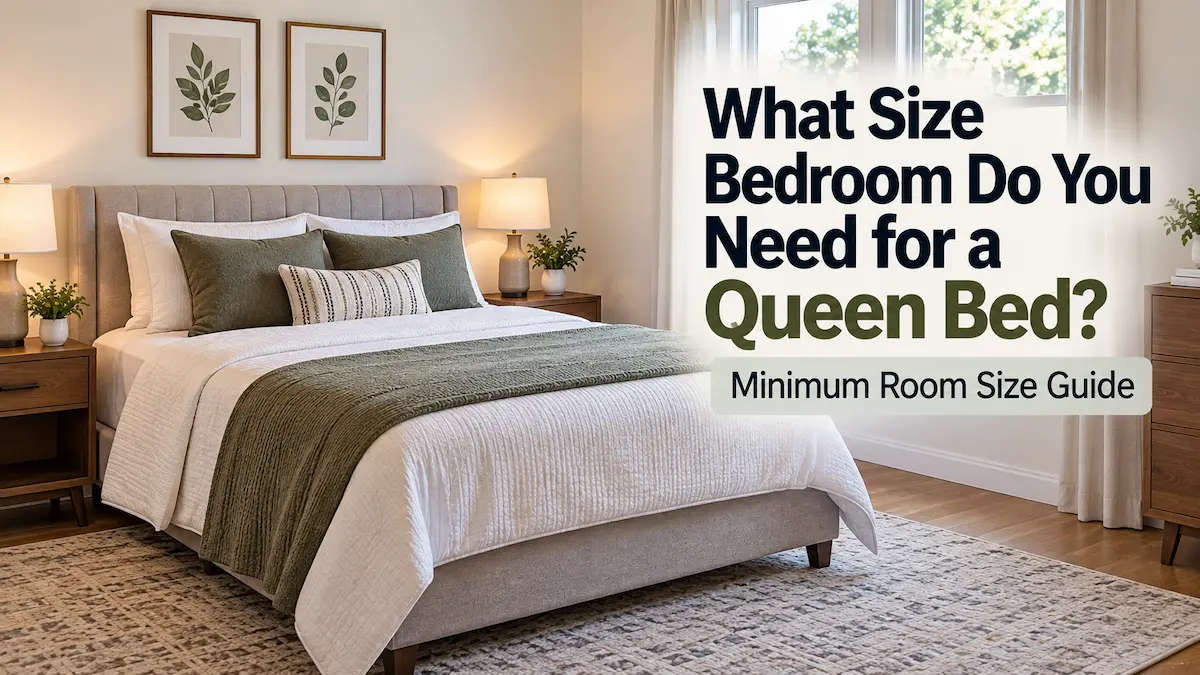
A queen bed is forgiving enough to fit in many small bedrooms, but one dimension matters more than people expect: room width. A 9×12 bedroom has more total floor area than a 10×10, yet the 10-foot-wide room can give you more usable space on both sides of a centered queen.
That is why I would treat 10×10 feet as a realistic compact starting point, not a universal minimum. A 9×10 can work when the bed is the clear priority. A 10×12 is much easier to furnish because the extra depth gives you room for a dresser or wider path at the foot. An 11×12 or 12×12 feels noticeably less constrained.
A standard U.S. queen mattress is 60 inches wide by 80 inches long. The finished bed frame is usually larger, so use the manufacturer’s overall frame dimensions when you are working with a tight layout.
Why a 10-Foot-Wide Room Is Such a Useful Threshold
Start with the queen mattress itself: 60 inches wide.
A 10-foot wall is:
120 inches
Center the 60-inch mattress on that wall:
120 − 60 = 60 inches
Split the remaining space between both sides:
60 ÷ 2 = 30 inches per side
That is a useful amount of everyday side access for many bedrooms.
Now account for the frame. Sleep Foundation notes that queen frames commonly add roughly 2 to 5 inches beyond the 60×80 mattress footprint depending on the design. Its queen bed-frame sizing guide is a useful reference before you plan a tight room.
If your actual frame is 64 inches wide:
120 − 64 = 56 inches
56 ÷ 2 = 28 inches per side
That is why 10 feet of room width is often workable even after the frame is included.
A Bigger Room Can Still Have Worse Bedside Access
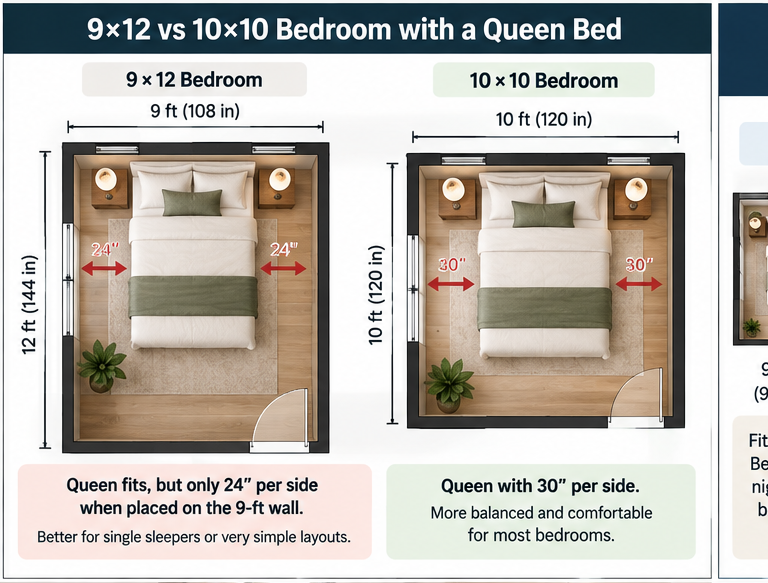
Square footage does not tell you how the bed will fit.
Compare these two bedrooms:
- 9×12 = 108 square feet
- 10×10 = 100 square feet
The 9×12 is technically larger.
But put the queen headboard on the 9-foot wall:
108 − 60 = 48 inches
48 ÷ 2 = 24 inches per side
In the smaller 10×10 room:
120 − 60 = 60 inches
30 inches per side
The 9×12 gives you more floor at the foot of the bed. The 10×10 gives you better access along both sides.
Neither room is automatically “better.” The useful question is whether you need more side clearance or more room depth.
What the Common Queen-Bed Room Sizes Actually Give You
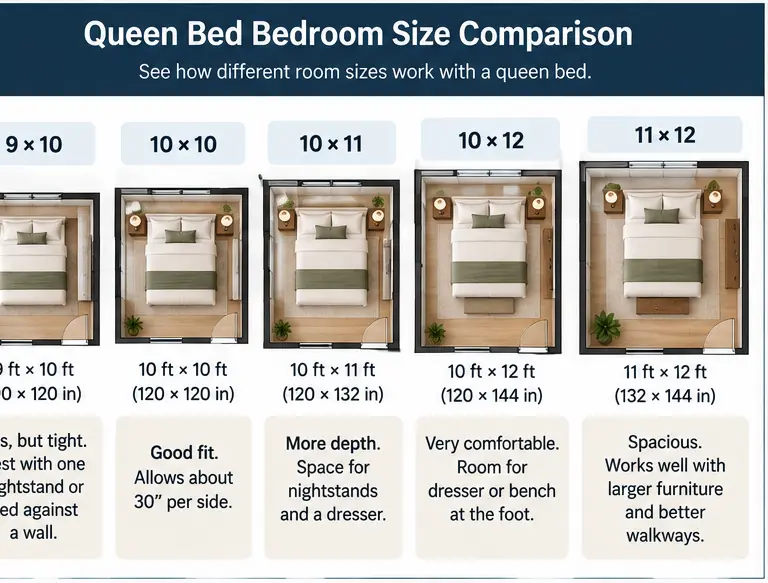
9×10: possible, but the bed dominates
A queen centered on the 9-foot wall leaves about 24 inches beside each side of the mattress.
With a 64-inch-wide frame:
108 − 64 = 44 inches
22 inches per side
This can work well for a guest room, one-person bedroom, or a room where sleeping space matters more than extra furniture. Keep the frame slim and use narrow nightstands, wall-mounted shelves, or sconces rather than large bedside tables.
10×10: a practical compact bedroom
A 10×10 is much easier to use on both sides of the bed. With the mattress, you have about 30 inches per side; with a 64-inch frame, about 28 inches.
The compromise appears at the foot.
If the frame is 84 inches long:
120 − 84 = 36 inches
That is a reasonable open walkway. But put a 20-inch-deep dresser on the opposite wall:
36 − 20 = 16 inches
Now the room becomes restrictive, even before the dresser drawers open.
So 10×10 works best when storage is on a side wall, inside the closet, or under the bed rather than directly opposite the foot.
10×11 or 11×10: same area, two very different layouts
This is where orientation starts to matter more than the room label.
Put the headboard on the 10-foot wall and you keep roughly the same side access as a 10×10, but gain another foot at the foot of the bed.
Put the headboard on the 11-foot wall and the mattress has:
132 − 60 = 72 inches
36 inches per side
You gain wider bedside aisles, but the room depth returns to 10 feet.
Choose the orientation based on the dresser, doors, closet, windows, and nightstand sizes—not simply by placing the headboard on the longest wall.
10×12: the best all-around target for many queen bedrooms
The queen still has roughly the same side access when the headboard sits on the 10-foot wall. The major improvement is the extra room depth.
With an 84-inch-long frame:
144 − 84 = 60 inches
Add a 20-inch-deep dresser opposite the bed:
60 − 20 = 40 inches
That is a much more useful furniture layout than the 16-inch gap in the 10×10 example.
This is why 10×12 is the size I would choose over 10×10 when a dresser opposite the bed matters.
11×12 and 12×12: room to stop counting every inch
In an 11-foot-wide room, a 60-inch queen mattress has about 36 inches of side clearance when centered. A 64-inch frame still leaves about 34 inches per side.
At 12 feet wide, those numbers grow to about 42 inches beside the mattress or 40 inches beside a 64-inch frame.
You do not need this much room simply to own a queen bed. What you gain is flexibility: wider nightstands, a chair, desk, bench, larger dresser, or more forgiving door and closet placement.
Nightstands Need Their Own Wall Calculation
Do not assume that 28 or 30 inches of side aisle means you can simply place a 28-inch nightstand there. The nightstands occupy the head-of-bed zone, so calculate the whole headboard wall separately.
Suppose you have:
- 64-inch-wide bed frame;
- two 20-inch nightstands;
- 2 inches between the frame and each nightstand.
Total width:
64 + 20 + 20 + 2 + 2 = 108 inches
On a 10-foot wall:
120 − 108 = 12 inches of unused wall width
That is workable.
Change the nightstands to 24 inches each:
64 + 24 + 24 + 2 + 2 = 116 inches
Now only 4 inches remain across the entire 120-inch wall.
The furniture technically fits, but outlets, baseboards, curtains, window trim, and small measurement differences leave almost no flexibility.
Room Depth Matters Most When a Dresser Faces the Bed
If a dresser sits opposite the foot, use this formula:
room depth − bed-frame length − dresser depth = closed walking space
Using an 84-inch frame and a 20-inch dresser:
| Room depth | Clear space between bed and dresser |
|---|---|
| 10 ft (120 in.) | 16 in. |
| 11 ft (132 in.) | 28 in. |
| 12 ft (144 in.) | 40 in. |
The jump from a 10-foot-deep room to a 12-foot-deep room adds 24 inches of usable space exactly where a dresser needs it.
Then check the dresser with the drawers open. Static furniture dimensions are only part of the room.
Sometimes Putting One Side of the Bed Against a Wall Is the Better Layout
Two-sided access is convenient for couples, but it is not mandatory for every bedroom.
Pushing one side of a queen against the wall can free useful floor area for:
- a desk;
- larger dresser;
- reading chair;
- clearer entry path;
- more open space in a small apartment or guest room.
This works best for one sleeper, an occasional guest room, or a bedroom where another function matters more than equal access to both sides.
For two people using the bed every night, it is less convenient because one person may need to climb across the mattress and making the bed becomes harder.
How Much Space Does a Queen Save Compared With a King?
Queen and king mattresses are both 80 inches long, but a king is 76 inches wide while a queen is 60 inches wide. Sleep Foundation’s current queen-vs.-king comparison confirms those standard dimensions.
The queen is therefore:
16 inches narrower
Centered in the same room, that returns:
8 inches to each side
In a 10-foot-wide bedroom:
- queen: about 30 inches per side of the mattress;
- king: about 22 inches per side.
That eight-inch difference on each side is substantial in a compact room.
Would a full bed solve a tight queen layout?
A full mattress is about 54 inches wide by 75 inches long. Compared with a queen, it saves only 6 inches of total width and 5 inches of length.
Centered in the room, that gives you only about 3 extra inches per side. If your queen layout is short by 10 or 12 inches, switching to a full may not solve as much as you expect.
If you are still considering the larger mattress, compare these numbers with the bedroom size needed for a king bed before deciding whether the extra width is worth the reduced floor space.
Tape the Furniture, Not Just the Mattress
If you are deciding whether a queen will work, tape the actual layout on the floor before ordering.
- Measure the room wall to wall.
- Find the bed frame’s overall width and length.
- Tape the full frame footprint onto the floor.
- Mark both nightstands.
- Mark the dresser and the space its drawers need when open.
- Open the bedroom, closet, and bathroom doors.
- Walk from the entry to both sides of the bed, around the foot, and to the closet.
This test often changes the answer. A 10×10 room may feel perfectly usable with a side-wall dresser and slim nightstands, while a larger room can feel awkward if doors interrupt the only good bed wall.
Once the bed position is settled, the next measurement is the rug size under a queen bed, especially if you want the rug to extend beyond both sides and the foot.
The Size I Would Choose
9×10: acceptable when the queen is the priority and furniture is minimal.
10×10: a realistic compact starting point. Good bedside access, but furniture opposite the bed can be difficult.
10×11 or 11×10: useful because you can choose between more room depth and more side clearance.
10×12: the best all-around target for many queen bedrooms, especially if you want a dresser opposite the bed.
11×12 or 12×12: comfortable rather than merely workable, with much more freedom for nightstands, storage, seating, or a desk.
If I had to reduce the article to one rule, it would be this: 10 feet of width makes a queen practical; extra room depth makes the rest of the bedroom practical.
Questions People Ask Before Choosing the Bed
Is a 10×10 room big enough for a queen bed?
Yes. A 60-inch queen mattress centered in a 10-foot-wide room leaves about 30 inches on each side. A 64-inch-wide frame leaves about 28 inches per side. The main limitation is usually furniture at the foot rather than bedside access.
Can a queen bed fit in a 9×10 room?
Yes, but expect a bed-dominant layout. A 60-inch mattress centered on the 9-foot wall leaves about 24 inches on each side before the frame is included. Slim bedside furniture works best.
Is 10×12 a good bedroom size for a queen?
Yes. It keeps useful side access while adding enough depth to make a dresser or wider walkway at the foot much easier to accommodate. For many homes, it is a stronger all-around target than 10×10.
Can two nightstands fit with a queen in a 10×10 room?
Often, yes, if they are reasonably narrow. A 64-inch frame plus two 20-inch nightstands and small gaps uses about 108 inches of a 120-inch wall. Two 24-inch nightstands leave much less tolerance.

One Comment