What Size Rug Goes Under a Sectional Sofa? Size & Placement Guide

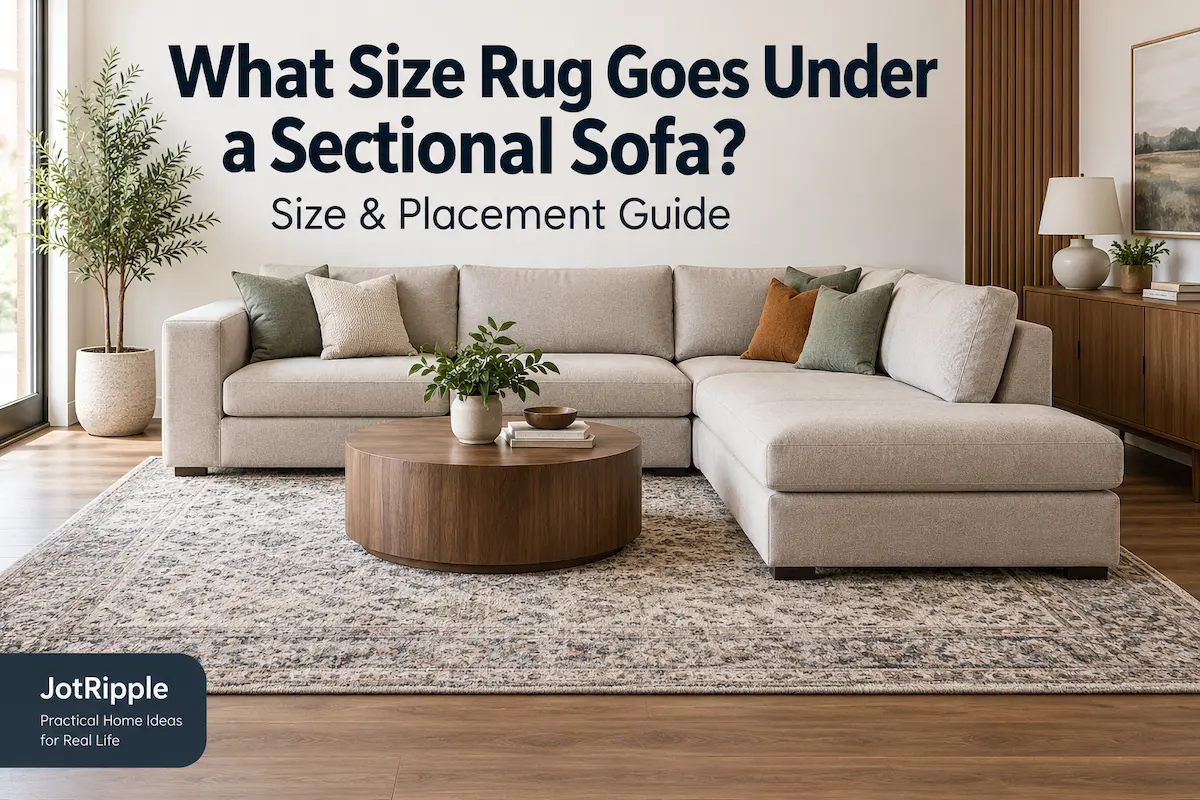
For a sectional sofa, choose the rug from the sectional’s complete footprint—not just the length of its longest side. An 8×10 can work with a compact sectional, a 9×12 is a useful size for many medium-to-large layouts, and a 10×14 or larger often works better with oversized or U-shaped sectionals.
The most reliable starting layout is to have the rug reach beneath the front legs of every major section of the sofa. That way, the chaise, return, and main seating run all feel connected to the same zone instead of looking like separate pieces.
West Elm’s current living-room rug guide similarly recommends getting the front legs of the sofa onto the rug and identifies 8×10 as useful for a small sectional and 9×12 for sectionals and larger rooms. Rugs Direct also recommends sizing from the full sectional shape rather than one sofa dimension in its sectional rug sizing guide.
The Sectional Footprint Matters More Than the Sofa Length
A straight sofa mostly occupies one long horizontal line. A sectional occupies space in at least two directions.
An L-shaped sectional might be 108 inches across the back but extend another 70, 80, or 90 inches into the room because of the chaise or return. A U-shaped sectional can occupy even more depth.
So measure two things:
- overall width: from the outer edge of one end to the farthest outer edge on the other;
- maximum depth: from the back of the sectional to the front edge of the deepest chaise or return.
Those two measurements describe the real furniture footprint.
Then decide how much of that footprint you want on the rug.
Choose the Placement Before You Choose the Rug Size
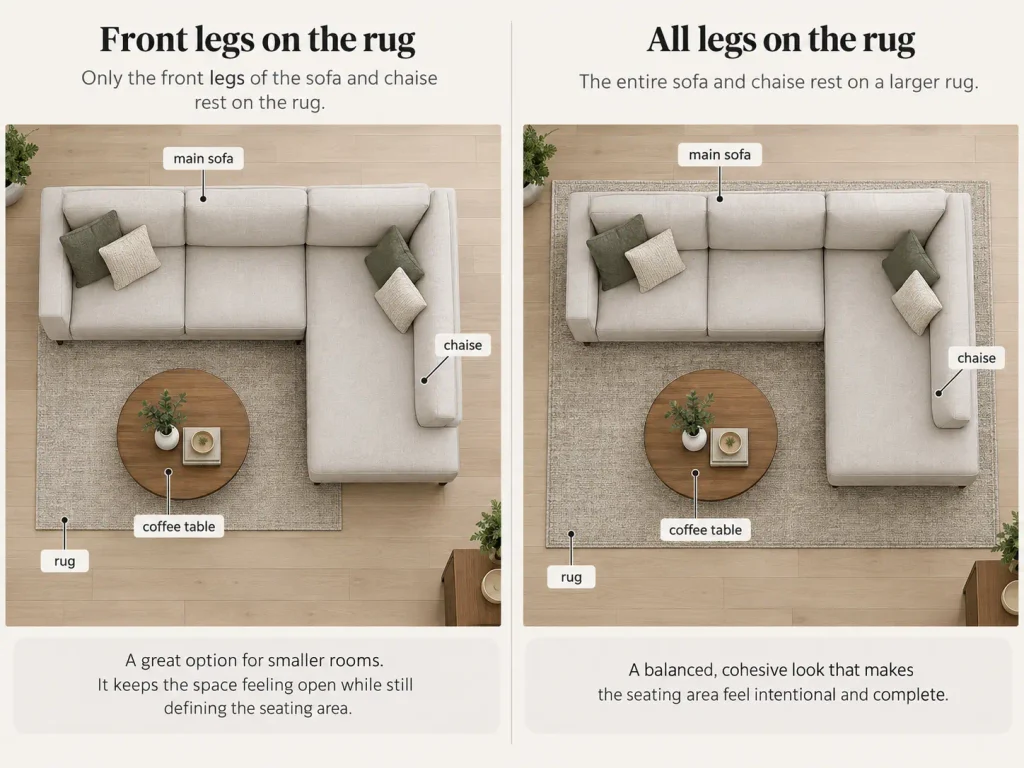
There are three practical sectional-and-rug relationships.
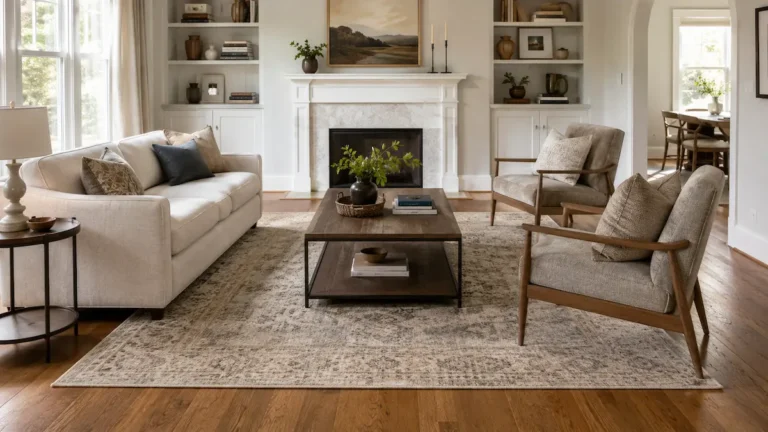
Front legs on the rug
This is the most flexible option for many living rooms. The rug reaches beneath the front legs or front support points of the main sofa section and the chaise or return.
The back legs stay on the floor, while the coffee table usually sits fully on the rug.
This approach visually connects the seating group without requiring the rug to cover the sectional’s entire footprint.
All legs on the rug
This works especially well in large living rooms and open-plan spaces where the sectional floats away from the walls.
Because the entire sofa footprint sits on the rug, you generally need a substantially larger size—often 9×12, 10×14, 12×15, or custom depending on the furniture.
The rug should still remain visible around the sectional. If almost all of it disappears beneath the sofa, the layout can look undersized even though the furniture technically fits.
Rug mostly inside the sectional
In a tight room, a rug can sit primarily in the open area in front of the sectional, sometimes catching only a small portion of the front edge.
This can work, but be careful not to reduce the rug to a coffee-table mat. If the rug has no meaningful visual relationship with the sectional, the seating group can look disconnected.
If you’re working with a straight sofa rather than a sectional, our living room rug size guide compares the front-legs-on, all-legs-on, and rug-in-front approaches in more detail.
Which Standard Rug Size Should You Test First?
Think of these as starting points rather than fixed sectional-size rules.
| Rug size | Where it tends to work best | Typical placement |
|---|---|---|
| 6×9 | Very compact sectional or small apartment layout | Mostly in front or shallow front-leg overlap |
| 8×10 | Small sectional or compact chaise sectional | Front legs on |
| 9×12 | Many full-size L-shaped and chaise sectionals | Front legs on; sometimes more furniture included |
| 10×14 | Large L-shaped, U-shaped, or open-plan seating group | Generous front-leg placement or all legs on |
| 12×15 / custom | Oversized modular or very large open-plan arrangement | Entire seating zone anchored |
The sectional’s depth, the position of the chaise, accent chairs, and room boundaries can all move you up or down from these starting sizes.
8×10 vs. 9×12 vs. 10×14: See the Difference in Inches
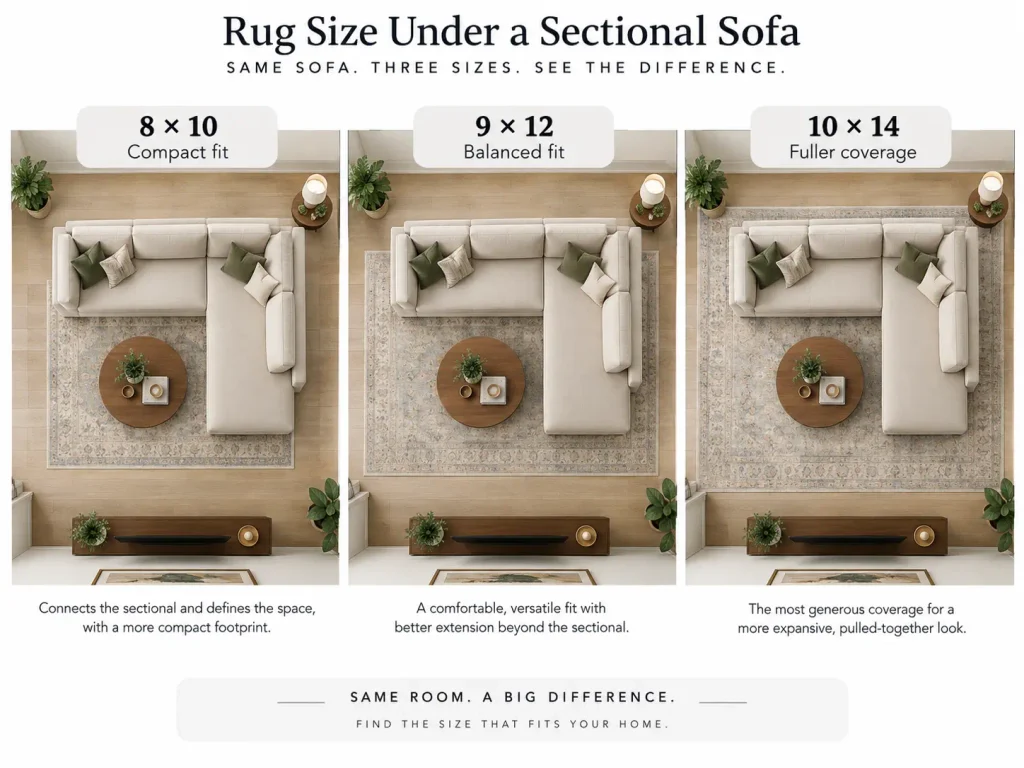
Converting the rug sizes to inches makes sectional planning much easier:
- 8×10 = 96×120 inches
- 9×12 = 108×144 inches
- 10×14 = 120×168 inches
Imagine the longest run of your sectional is 96 inches.
If the 120-inch side of an 8×10 runs parallel to it:
120 − 96 = 24 inches
Centered, that gives roughly:
12 inches beyond each end
Now use a 9×12 with the 144-inch side running parallel:
144 − 96 = 48 inches
48 ÷ 2 = 24 inches beyond each end
The sectional did not change. The larger rug simply gives the furniture group more visible breathing room.
This is why a 9×12 can look dramatically more balanced than an 8×10 even when both technically fit.
A 10-Foot Sectional Does Not Automatically Need a 10×14
A 10-foot sectional is 120 inches long, but that one number does not tell you the required rug size.
With a 9×12 rug, the 144-inch side could run parallel to the 120-inch sofa span:
144 − 120 = 24 inches
That is about:
12 inches beyond each end
With a 10×14:
168 − 120 = 48 inches
or:
24 inches beyond each end
Either could work. The deciding questions are how deep the chaise is, whether accent chairs need to join the rug, whether you want front legs or all legs on, and how much exposed floor remains around the rug.
Sectional Shape Changes the Answer
L-shaped sectional
The rug needs to connect both arms of the L.
A common mistake is placing the main sofa section convincingly on the rug while leaving the entire return outside it. The result makes the return look visually detached.
For a compact L-shape, test 8×10 first. For a larger layout, compare 9×12 and 10×14.
Sectional with a chaise
Treat the chaise as part of the furniture footprint, not as an optional add-on.
In a front-legs-on layout, the rug does not need to run beneath the full chaise length, but it should overlap enough that the chaise still belongs to the same rug zone.
If an 8×10 anchors the main sofa but leaves the chaise floating outside the arrangement, tape out a 9×12 and compare the two.
U-shaped sectional
A U-shaped sectional surrounds a large central area, so it usually requires more rug width and depth than an L-shape.
A smaller U-shaped configuration may work with a 9×12, but 10×14 or larger often gives the arrangement more convincing coverage.
Check both returns independently. The rug should not anchor one side well and stop abruptly before the other.
Modular sectional
Measure the configuration you actually use—not the largest arrangement shown in a manufacturer’s product gallery.
If you regularly move the modules, size the rug around the largest common configuration you expect to use. That gives you more freedom to rearrange the seating without making the rug suddenly look undersized.
Which Direction Should the Rug Run?
For most rectangular rugs, run the long dimension parallel to the longest visual run of the sectional.
For example, if a sectional stretches about 10 feet horizontally across the room, the 12-foot side of a 9×12 will usually run in that same direction.
This tends to give you useful rug exposure beyond both ends of the sofa.
But room architecture can override that approach. Fireplaces, built-ins, doorways, traffic paths, and unusually narrow rooms may make another orientation more practical.
Do Not Forget the Rest of the Seating Group
A rug under a sectional usually has to work with more than the sofa.
Before choosing the final size, account for:
- the coffee table;
- accent chairs;
- side tables;
- floor lamps;
- ottomans;
- walkways between the seating area and nearby rooms.
An accent chair does not always need all four legs on the rug, but it should feel intentionally connected to the same seating zone.
In an open-plan room, this becomes even more important because the rug often acts as the visual boundary between the living area and the dining or kitchen area.
How to Tell When the Rug Is Too Small
Instead of relying on one measurement, look for a combination of warning signs:
- only the coffee table sits on the rug;
- one arm of the sectional connects to the rug while the other floats outside it;
- almost the entire rug disappears beneath the sofa;
- the rug stops exactly at the outer arm with no visible extension;
- an accent chair cannot connect with the same rug zone;
- the sectional looks visually heavier than the rectangle beneath it.
If several of these happen at once, test the next standard rug size up.
Rugs Direct recommends roughly 12 to 24 inches of extension beyond open sides of a sectional as a useful general target, though the available room should ultimately determine what works. See its sectional sizing guidance.
Can a Round Rug Work With a Sectional?
Yes, but a round rug is usually a more deliberate design choice.
It works best when the open center of the sectional already forms a strong circular or curved focal area and the coffee table reinforces that shape.
For a large L-shaped or U-shaped sectional, a rectangular rug is usually easier to scale because its straight edges follow the major furniture lines.
Do not choose a round rug only because a rectangular rug feels difficult to fit. Choose it because the shape improves the composition.
Use Painter’s Tape Before You Spend the Money
Sectional rugs get expensive quickly as the size increases, so this is one category where a tape test is especially worthwhile.
If you are deciding between an 8×10 and a 9×12:
- Mark a 96×120-inch rectangle for the 8×10.
- Place the sectional exactly where it normally sits.
- Check whether the front legs of the main section and chaise both reach the outline.
- Look at the visible rug beyond the sofa ends.
- Mark a second 108×144-inch outline for the 9×12.
- Add the coffee table and accent-chair positions.
- Check doors, vents, cabinets, and walkways.
- Stand in the doorway or adjoining room and compare the two outlines from a distance.
If both sizes fit comfortably, the larger rug often creates a more unified furniture group. If the larger outline starts crowding circulation or neighboring zones, the smaller size may be the better fit.
My Starting Point for a Sectional
If I were choosing without seeing the room, I would start this way:
- compact sectional: test an 8×10;
- full-size L-shaped or chaise sectional: test a 9×12;
- large L-shaped, U-shaped, or open-plan arrangement: test a 10×14;
- oversized modular setup: compare 12×15 or custom dimensions.
Then I would ignore the label and look at the floor.
The correct rug is the one that connects the entire seating group, gives the sectional enough visible rug around it, and still leaves the room’s walkways and neighboring zones functioning normally.
Questions People Ask About Sectional Rugs
Is an 8×10 rug big enough for a sectional?
Yes, especially for a compact sectional using front-legs-on placement. If the rug reaches the main sofa but fails to connect the chaise or return, test a 9×12.
Is a 9×12 rug good for a sectional?
Yes. A 9×12 is a useful size to test for many full-size sectionals because it provides more visible rug around the seating group than an 8×10 while still fitting many standard living rooms.
Should a rug extend past the ends of a sectional?
Some visible rug beyond the outside ends usually helps the rug look intentional and proportional to the seating group. There is no single required extension; use the sectional dimensions and available room space to determine the amount.
Does the entire chaise need to sit on the rug?
No. In a front-legs-on arrangement, only the front portion may overlap the rug. The important point is that the chaise remains visually connected to the same rug and furniture grouping.