
What Size Rug Goes Under a King Bed? Size & Placement Guide


A king bed is wide enough that the same rug can look completely different depending on which way you turn it. That is why “use a 9×12” is only half an answer.
For many king-bed layouts, 9×12 is the best size to test first. An 8×10 can work when the rug starts in front of the nightstands and sits under only the lower portion of the bed. A 10×14 makes more sense when the bedroom is large or you want the rug to include nightstands, a bench, and more of the surrounding floor area.
Before choosing one, decide what you want the rug to do: provide a soft landing beside the bed, anchor the whole sleeping zone, or simply add bedside comfort without putting a large rug under the mattress.
Choose the Placement Strategy Before You Choose the Rug
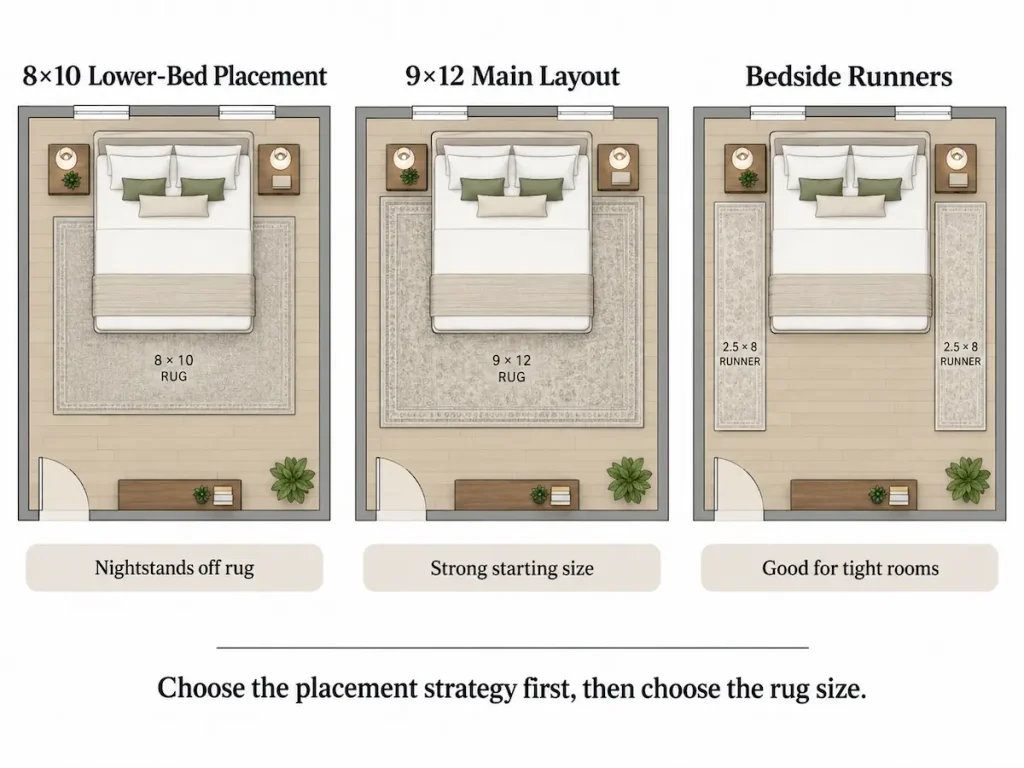
There are three practical ways to use a rug with a king bed. The best size changes with the placement.
1. Lower-bed placement: nightstands stay off the rug
The rug begins in front of the nightstands and runs beneath the lower part of the bed. This puts more of the rug where your feet actually land while avoiding several feet of rug hidden beneath the headboard area.
This is the most realistic use for an 8×10, and it can also work with a 9×12 when the bedroom is not large enough for full furniture coverage.
2. Full sleep-zone placement: bed and nearby furniture feel connected
A larger rug extends farther toward the headboard and may include the nightstands, the full bed footprint, or a bench at the foot.
A 9×12 can work for many king beds, while a 10×14 gives substantially more flexibility in a large primary bedroom.
3. Runners: comfort without a large under-bed rug
If a large rug would crowd the room, runners can provide softness along one or both sides of the bed without covering the floor beneath the mattress.
This is not a second-best solution. In a narrow bedroom, it can be the more practical layout because it preserves walking space and keeps doors and furniture clear.
Rugs Direct’s current king-bed rug guide likewise treats 9×12 as its strongest overall king-bed option, 8×10 as a partial-placement alternative, and side runners as a workable option when a full-size rug does not fit.
Why a 9×12 Can Produce Two Very Different King-Bed Layouts
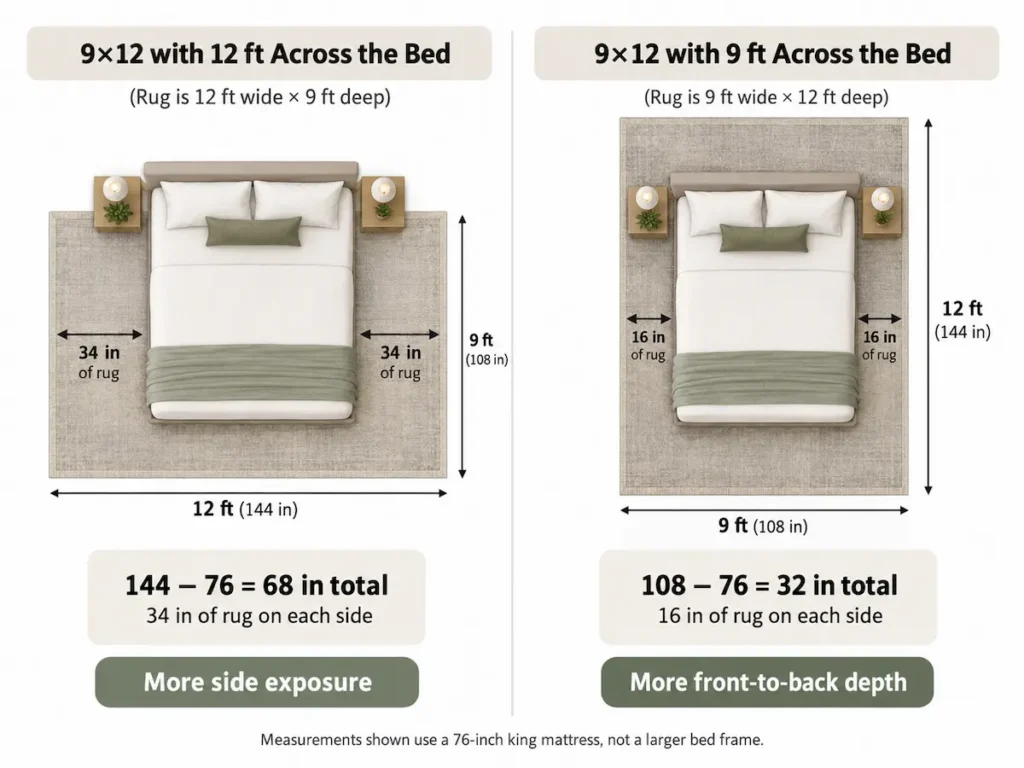
A standard U.S. king mattress measures about 76 inches wide by 80 inches long. A California king is narrower and longer at about 72 by 84 inches. Those dimensions are standardized mattress sizes; the actual bed frame is often larger. Sleep Foundation’s king-size guide lists those standard dimensions and is a useful reference when checking the basic mattress footprint.
Now look at what happens when you turn a 9×12 rug.
Option A: 12-foot side across the bed
The 12-foot dimension is 144 inches.
With a 76-inch king mattress:
144 − 76 = 68 inches
Centered beneath the mattress:
68 ÷ 2 = 34 inches of rug on each side
That is generous side coverage. But the other rug dimension is only 9 feet, or 108 inches, so this orientation is usually better when the rug begins partway down the bed rather than trying to cover everything from the headboard through the foot.
Option B: 9-foot side across the bed
The 9-foot dimension is 108 inches.
With the same 76-inch mattress:
108 − 76 = 32 inches
Centered:
32 ÷ 2 = 16 inches per side
You get less side exposure, but now the 12-foot dimension runs from the head of the bed toward the foot. That gives much more front-to-back depth and can work better when the rug needs to sit farther beneath the bed or include more of the furniture grouping.
This is why a generic statement such as “a 9×12 gives X inches around a king bed” can be misleading. Orientation and placement have to be specified.
An 8×10 Works Best When You Stop Asking It to Cover Everything
An 8×10 is often described as too small for a king bed. That is fair if you expect the rug to sit beneath the entire bed, nightstands, and a bench. But it can work well as a lower-bed rug.
Turn the 10-foot side across the bed:
120 − 76 = 44 inches
Centered beneath the mattress:
44 ÷ 2 = 22 inches per side
The side coverage is not the main problem. The limitation is the 8-foot depth.
An 8-foot rug is 96 inches long. A king mattress is already 80 inches long, so trying to run the rug from the head of the mattress to the foot would leave only 16 inches of extra depth in total.
Instead, start the rug in front of the nightstands and let it extend beneath the lower portion of the bed. That concentrates the rug beside the places where people step and gives the rug more visible presence at the foot.
An 8×10 is worth considering when:
- the bedroom is compact;
- the nightstands will remain off the rug;
- you mainly want softness beside and at the foot of the bed;
- the bed frame is not unusually wide;
- a 9×12 would crowd doors, dressers, or wall space.
A 10×14 Is a Room-Scale Choice, Not a King-Bed Requirement
A king mattress does not automatically require a 10×14 rug. This size becomes useful when the room and furniture grouping are large enough to justify it.
A 10×14 can make sense when you want to include:
- the full bed footprint;
- both nightstands;
- a substantial bench or stools at the foot;
- more walking area around the sleeping zone.
It also gives you more freedom to choose orientation based on the shape of the room rather than trying to squeeze every inch of side exposure from the rug.
But size up only if the room supports it. A 10×14 that nearly touches several walls, runs awkwardly under unrelated furniture, covers floor vents, or interferes with doors is not an upgrade over a correctly placed 9×12.
Your Bed Frame Can Change the Math More Than You Expect
The mattress is only a reference measurement. Upholstered rails, a platform, a footboard, or a wide frame can add several inches to the actual furniture footprint.
Suppose your king mattress is 76 inches wide but the outside of the frame measures 84 inches.
If a 9-foot rug dimension runs across the frame:
108 − 84 = 24 inches
Centered:
24 ÷ 2 = 12 inches of visible rug per side
Using the mattress alone would have suggested 16 inches per side.
That four-inch difference on each side is enough to change how generous the rug feels. Measure the outside edges of the actual frame before buying.
Nightstands: Keep the Placement Consistent
Nightstands do not have to sit on the rug.
With an 8×10 lower-bed layout, they will usually remain completely off it. That is often the cleanest solution.
With a 9×12 or 10×14, you may choose to bring the rug farther toward the headboard. If the nightstands sit on the rug, make sure they are stable. A thick rug under only some of the feet can make a nightstand rock.
The important point is consistency. Two matching nightstands should normally have the same relationship to the rug rather than one sitting on it while the other is off.
A Bench at the Foot Changes the Required Depth
A king bed may fit comfortably on a 9×12, but adding a deep upholstered bench can consume much of the rug that would otherwise remain visible at the foot.
Measure the full layout from the bed toward the front edge of the bench, then decide how much rug you want visible beyond it.
A compact bench may fit comfortably with a 9×12 depending on placement. A wider or deeper bench, especially when combined with nightstands on the rug, can make a 10×14 more appropriate.
Do not leave a bench with some feet on a thick rug and others on hard flooring if that makes it unstable.
What If the Bedroom Is Too Small for a 9×12?
Do not force a 9×12 into the room simply because it is the most common king-bed recommendation.
If a 9×12 crowds the walls or blocks other furniture, you have better options:
- 8×10 under the lower portion: preserves side comfort without filling the whole room.
- Two runners: gives each sleeper a soft landing area.
- One runner: useful when one side of the bed is close to a wall or used much less often.
- Smaller rug at the foot: more decorative than functional, but useful when no under-bed rug fits.
A 6×9 is generally too small to act like a conventional full king-bed rug. It can still work deliberately at the foot or partly beneath the lower section, but it will not create the same visual foundation as an 8×10 or 9×12.
If space around the rug is becoming tight, check the bedroom size needed for a king bed before choosing the larger rug option.
California King: Similar Sizes, Different Proportions
A California king mattress is about 72 inches wide by 84 inches long, compared with 76 by 80 inches for a standard king. The California king therefore needs slightly less rug width but slightly more front-to-back depth.
A 9×12 can still work very well. What changes is the balance: the extra four inches of mattress length makes depth more important, particularly if there is a bench at the foot or if the rug needs to extend toward the headboard.
Again, use the frame—not only the mattress—as your final measurement.
If your bedroom has a queen instead, use our queen bed rug size guide because the smaller mattress changes how much rug should show on each side.
Map the Rug on the Floor Before You Buy It
A king-bed rug is large enough that guessing from a product photo is risky. Painter’s tape gives you a much better preview.
Measure the actual bed frame, put the nightstands and bench where they will stay, and then tape the rug outline onto the floor.
Test the sizes in this order:
- Mark a 9×12 first.
- Check both possible orientations if the room allows them.
- If it crowds the room, tape an 8×10 in a lower-bed position.
- If it feels visually small or you want more furniture on the rug, test 10×14.
Then walk around the bed normally. Open the closet and entry doors. Pull out dresser drawers. Sit on the edge of the mattress. Check where your feet land.
Finally, use the actual product dimensions before ordering. A rug marketed as “9×12” may be slightly smaller or larger than exactly 108 by 144 inches.
Which Size Should You Test First?
Start with 9×12 if you have a conventional king bed and enough room around it. It gives you the most useful middle ground between compact partial coverage and an oversized room-scale rug.
Move to 8×10 when the bedroom is tighter and you are comfortable keeping the nightstands off the rug.
Move to 10×14 when the room is large, the bed frame is oversized, or the rug needs to anchor nightstands and a substantial bench as one group.
Use runners when bedside comfort matters more than having one large rug under the bed.
The size label is only the starting point. The final choice should make sense with your actual frame, furniture, rug orientation, and room clearance.
Questions That Matter Before Ordering
Is an 8×10 rug too small for a king bed?
Not if it is used intentionally. An 8×10 works best under the lower portion of a king bed with the 10-foot dimension running across the bed and the nightstands remaining off the rug. It is usually too small if you expect it to contain the entire bed and surrounding furniture.
Is 9×12 the best rug size for a king bed?
It is the strongest starting size for many standard king bedrooms. It can provide substantial coverage without demanding as much floor area as a 10×14. The final result depends on orientation, frame size, and how far the rug extends toward the headboard.
How much rug should show beside a king bed?
There is no single number that works for every placement. Current design guidance often aims for roughly 12 to 18 inches or more of visible rug around a king-bed layout, while some broader bedroom guides prefer 18 to 24 inches when the room and rug size allow it. Use your actual frame and make sure there is enough visible rug for your feet to land comfortably.
Which way should a 9×12 rug go under a king bed?
It depends on the placement. Running the 12-foot side across the bed creates much more side exposure and works well with partial placement. Running the 9-foot side across the bed gives less side exposure but much more rug depth from head to foot. Test both orientations against the furniture arrangement rather than treating one direction as universally correct.


One Comment