
What Size Rug Goes Under a Queen Bed? Size & Placement Guide

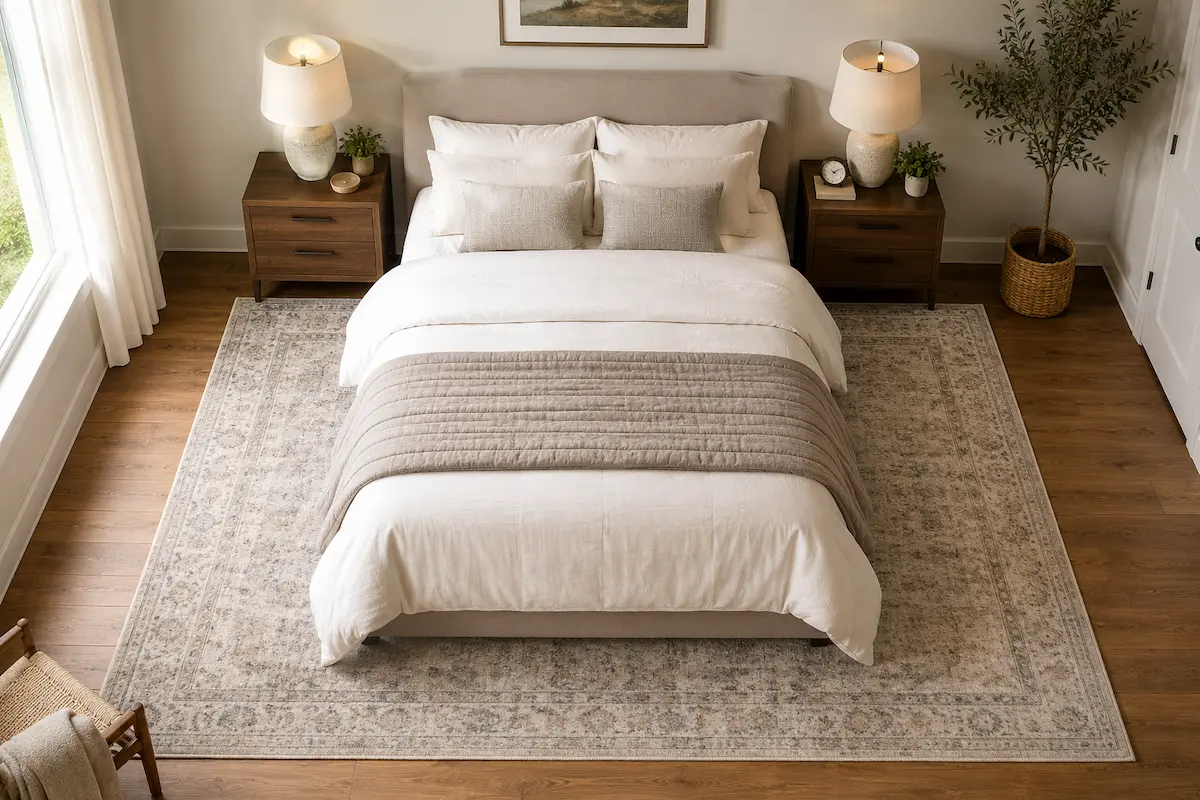
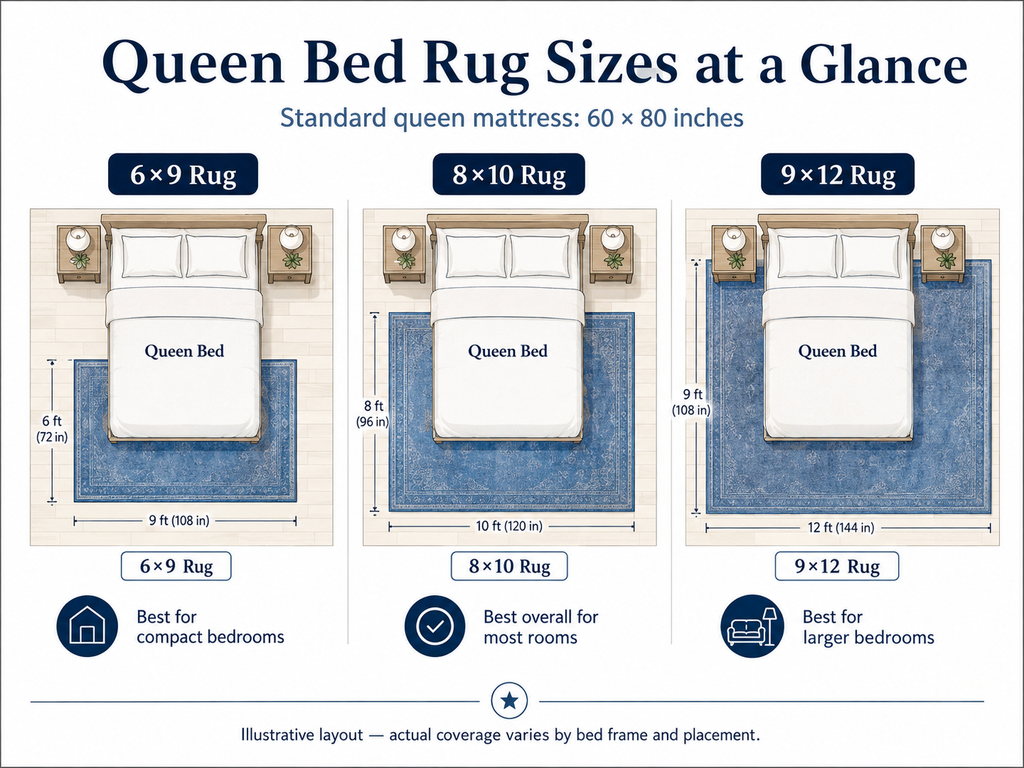
For most queen beds, an 8×10 rug is the best all-around size. It gives enough coverage beside and at the foot of the bed without overwhelming a typical bedroom. A 6×9 rug can work well in a smaller room when placed under the lower portion of the bed, while a 9×12 rug is better for a larger bedroom or a layout where the rug extends beneath the nightstands.
The right size, however, depends on more than the mattress. Your bed frame, bedroom dimensions, nightstands, bench, rug orientation, and how much exposed rug you want all affect the final fit.
Queen Bed Rug Size at a Glance
A standard U.S. queen mattress measures 60 inches wide by 80 inches long. The bed frame itself is usually a little larger than the mattress, so measure the actual bed before buying a rug.
| Rug Size | Does It Work With a Queen Bed? | Best For |
|---|---|---|
| 5×8 | Sometimes | Small room, foot-of-bed or partial placement |
| 6×9 | Yes | Compact bedroom, lower-bed placement |
| 8×10 | Best overall | Most queen bedrooms |
| 9×12 | Yes | Large bedroom, fuller furniture coverage |
| 10×14 | Usually larger than necessary | Oversized primary bedroom |
If you are unsure which size to choose, start by testing an 8×10 footprint with painter’s tape on the floor. Current bedroom-rug guidance commonly treats 8×10 as a strong starting point for queen beds, with larger rugs such as 9×12 providing more furniture coverage in bigger rooms. You can compare those layouts in this queen-bed rug sizing guide.
Why an 8×10 Rug Works Best for Most Queen Beds
An 8×10 area rug gives a queen bed enough surrounding rug to feel intentional rather than undersized.
But there is an important detail that many size guides overlook:
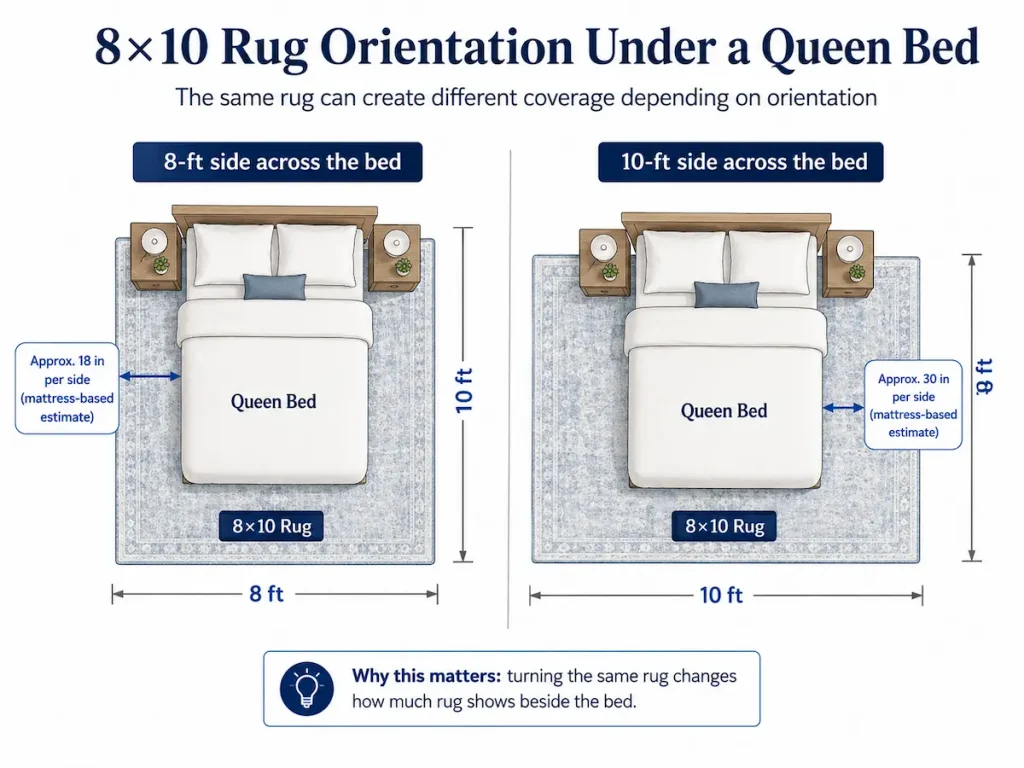
The direction you turn the rug changes the amount of rug visible beside the bed.
A queen mattress is 60 inches wide. If the 8-foot side of an 8×10 rug runs across the width of the bed, that side measures 96 inches.
The approximate exposed rug on each side is:
(96 − 60) ÷ 2 = 18 inches
That gives approximately 18 inches of rug on each side of the mattress.
Turn the same rug so its 10-foot side runs across the bed, and you get:
(120 − 60) ÷ 2 = 30 inches
That creates approximately 30 inches on each side.
Those numbers use the mattress dimensions. Your actual exposed area will usually be slightly smaller once the bed frame is included. Sleep Foundation notes that queen bed frames vary by design and can add extra width and length beyond the mattress itself; see its queen bed frame size guide.
That is why two bedrooms can use the same 8×10 rug and look completely different. You can check our detailed guide on bedroom size for a queen bed.
A Simple Formula You Can Use
When deciding how much rug will show beside your bed:
Side exposure = (rug dimension across bed − actual bed width) ÷ 2
Measure your bed frame, not just the mattress.
For example, if your frame is 64 inches wide and you place the 96-inch side of the rug across it:
(96 − 64) ÷ 2 = 16 inches
You would have about 16 inches of visible rug on each side.
This quick calculation is more reliable than buying a rug based only on the words “queen bed.”
Can You Put a 5×8 Rug Under a Queen Bed?
A 5×8 rug can work under a queen bed, but it is usually too small for a full under-bed layout.
The best use for a 5×8 is beneath the lower portion of the bed or centered near the foot.
If the 8-foot dimension runs across the 60-inch-wide queen mattress, you have roughly 18 inches of rug extending beyond each side before accounting for the bed frame. That sounds reasonable, but the rug’s shorter 5-foot dimension limits how far it can extend beneath and beyond the bed.
For that reason, a 5×8 works best when:
- the bedroom is small
- you mainly want softness where your feet touch the floor
- the nightstands stay completely off the rug
- the rug is intentionally positioned beneath the lower half of the bed
Avoid pushing a small rug almost entirely beneath the mattress. If only a few inches remain visible, the rug can look undersized.
In a very tight room, two runners beside the bed can sometimes be more practical than forcing a small rectangular rug underneath it.
Does a 6×9 Rug Work Under a Queen Bed?
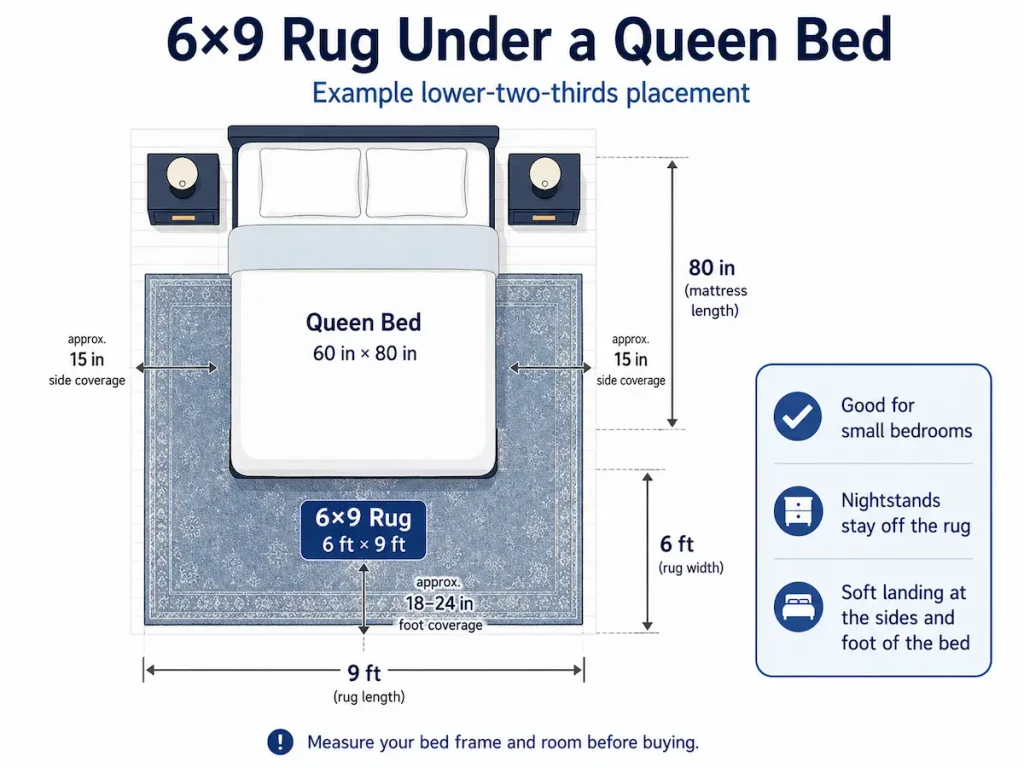
Yes. A 6×9 rug is a practical option for a queen bed in a smaller bedroom, especially when it sits beneath the lower portion of the bed instead of extending all the way to the headboard.
With the 9-foot side running across the bed, a 6×9 rug measures 108 inches across. Compared with a 60-inch queen mattress, that gives:
(108 − 60) ÷ 2 = 24 inches
So you can theoretically have about 24 inches on each side of the mattress before accounting for the frame.
The limitation is the other dimension. A 6-foot length gives less front-to-back coverage than an 8×10 or 9×12.
That makes 6×9 useful when you want good side coverage without filling most of a compact bedroom with rug.
Is an 8×10 Rug Big Enough for a Queen Bed?
Yes. For most bedrooms, an 8×10 rug is big enough for a queen bed and is the size to check first.
It offers a useful balance between:
- visible rug beside the bed
- coverage at the foot
- cost
- room proportion
- flexibility in placement
An 8×10 can be positioned with the nightstands completely off the rug, with the rug starting just in front of them, or farther toward the head of the bed depending on the room.
Which Way Should an 8×10 Rug Go Under a Queen Bed?
There is no single correct orientation.
For many bedrooms, placing the 10-foot dimension across the width of the bed creates generous coverage on the sides and works well when the rug begins farther down the bed.
Alternatively, running the 8-foot dimension across the bed can work when you want the 10-foot length to extend farther toward the head and foot of the room.
Decide based on the floor space you actually want covered.
Before ordering the rug, mark both orientations with painter’s tape. Walk around the bed, open doors and drawers, and check where your feet land when getting out of bed.
That simple test is more useful than following a diagram without considering your room.
When Should You Use a 9×12 Rug Under a Queen Bed?
A 9×12 rug is a better choice when the bedroom is large or you want the rug to anchor more of the furniture arrangement.
Compared with an 8×10, a 9×12 gives you considerably more flexibility.
It can work especially well if you want:
- nightstands on the rug
- a bench at the foot of the bed
- more exposed rug around the entire bed
- a stronger visual boundary around the sleeping area
A larger rug can also prevent a queen bed from looking isolated in a spacious primary bedroom.
But bigger is not automatically better.
In a small bedroom, a 9×12 may leave very little visible flooring around the perimeter. It can also interfere with doors, vents, or other furniture.
The rug should complement the available floor area rather than simply being the largest size that fits.
How to Position a Rug Under a Queen Bed
There are three practical ways to place an area rug around a queen bed.
1. Under the Lower Portion of the Bed
This is one of the most flexible layouts.
The rug begins partway down the bed, leaving the nightstands on the flooring while providing rug beside the lower part of the mattress and at the foot.
It works particularly well with 6×9 and 8×10 rugs.
This arrangement can also make moving or cleaning beneath the nightstands easier.
2. Under Most or All of the Bed
A larger rug can extend farther toward the headboard so the bed becomes completely anchored within the rug area.
This layout typically works better with 8×10 or 9×12 rugs, depending on the room and orientation.
If the nightstands sit on the rug, put them fully on it rather than awkwardly half on and half off. Rugs Direct makes the same practical point in its room-by-room rug sizing guide.
3. Runners Beside the Bed
You do not have to place one large rug underneath the mattress.
In narrow bedrooms, runners on one or both sides can provide the soft landing people usually want from a bedroom rug without taking up valuable floor space beneath the bed.
This can be especially useful in rentals, small apartments, or rooms where a larger rug would interfere with other furniture.
How Much Rug Should Show Around a Queen Bed?
A common design starting point is roughly 18 to 24 inches of visible rug around the accessible sides and foot of the bed, although your room does not fail simply because you have slightly more or less.
Treat this as a starting point, not a rigid rule.
A small bedroom may look better with less exposed rug. A large primary bedroom may need more.
Also remember that the measurement should be based on your bed frame, not merely the 60-inch mattress.
A substantial upholstered bed, storage frame, or frame with wide side rails may add several inches to the overall width and length.
Choose the Rug Based on Your Bedroom Size
The queen mattress is only one part of the equation.
You should also measure:
- the room
- the complete bed frame
- the nightstands
- any bench or seating
- door swings
- closets
- floor vents
- the distance between the proposed rug edge and nearby walls
As a practical starting point:
Small bedroom: Consider 5×8 or 6×9 with partial placement.
Average bedroom: Start by testing an 8×10 footprint.
Large bedroom: Compare 8×10 with 9×12.
Do not treat those as fixed room-size rules. Bedroom layouts vary too much for that.
A better method is to outline your proposed rug with painter’s tape.
Walk around the bed. Open the closet. Pull out drawers. Sit on the edge of the mattress. This quickly shows whether the rug footprint feels too small or too dominant.
Common Queen-Bed Rug Sizing Mistakes
The most common mistake is buying based only on the mattress size.
A queen mattress may be 60×80 inches, but the furniture sitting on top of the rug is usually larger.
Other common problems include:
- choosing a rug so small that most of it disappears beneath the bed
- forgetting to check rug orientation
- leaving a nightstand half on and half off the rug
- ignoring a bench at the foot of the bed
- placing the rug too close to walls or door swings
- ordering before marking the rug dimensions on the floor
Another mistake is assuming every recommendation for an “8×10 rug under a queen bed” describes the same layout.
It does not.
An 8×10 rug turned 90 degrees creates a completely different amount of side and foot coverage. Always check which dimension will run across your bed.
What Size Rug Should You Choose?
For a typical queen bedroom, 8×10 is the safest starting point.
Choose 6×9 if the room is compact and you plan to place the rug beneath only part of the bed.
Choose 9×12 if you have a larger room, want more floor coverage, or want the rug to include more furniture.
A 5×8 can work, but it is best treated as a partial-placement or accent solution rather than the default queen-bed size.
Most importantly, measure your actual bed frame and room before ordering.
The label on the rug tells you its dimensions. It does not tell you how those dimensions will look in your bedroom.
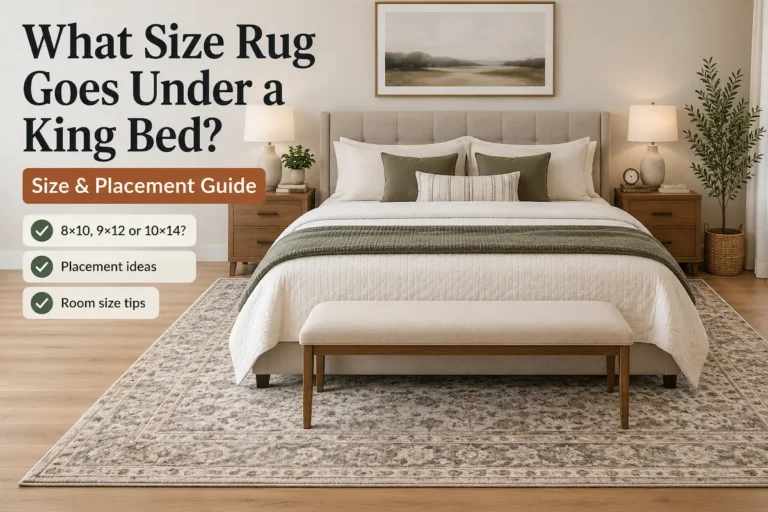
If you are furnishing a larger bed instead, the proportions change considerably; see our rug size guide for a king bed for 8×10, 9×12 and 10×14 layouts.
Frequently Asked Questions
Is an 8×10 rug good for a queen bed?
Yes. An 8×10 rug is the best overall choice for most queen beds because it provides useful coverage around the sides and foot while fitting comfortably in many bedrooms. How much rug shows depends on its orientation and where it begins beneath the bed.
Can a 6×9 rug go under a queen bed?
Yes. A 6×9 rug works well under a queen bed in a smaller room, especially when the rug is positioned beneath the lower portion of the bed and the nightstands remain off it.
Is a 5×8 rug too small for a queen bed?
A 5×8 rug is generally small for a full queen-bed layout, but it can work under the lower half of the bed or as a rug centered near the foot. For more substantial coverage, consider 6×9 or 8×10.
Is a 9×12 rug too big for a queen bed?
Not necessarily. A 9×12 rug can be an excellent choice for a queen bed in a large bedroom, especially when you want the nightstands, bench, or more of the surrounding furniture connected by the rug.
Should nightstands sit on the rug?
They do not have to. With a partial under-bed layout, both nightstands can remain completely off the rug. With a larger layout, they may sit completely on the rug. Avoid having only part of each nightstand resting on the rug if it makes the furniture unstable.
Which direction should a rug go under a queen bed?
It depends on the rug size and the coverage you want. For an 8×10 rug, putting the 10-foot side across the bed gives more rug exposure beside the mattress, while putting the 8-foot side across the bed allows the 10-foot dimension to extend farther along the length of the bed. Measure both orientations before choosing.


One Comment